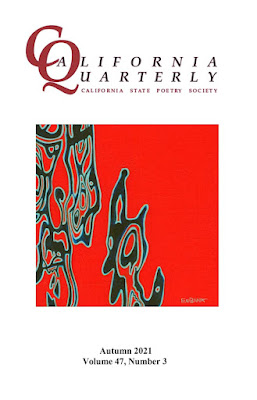
Wednesday, January 5, 2022

Poetry Letter No. 4, 2021 - Poems by Judy Barrat, Dave Malone, Pamela Stone Singer, Bruce Gallie and Jeanie Greensfelder

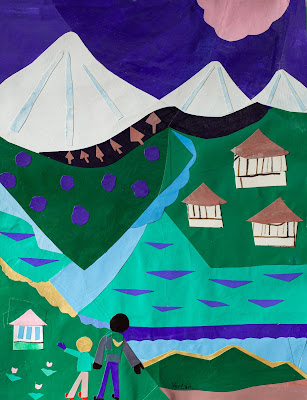
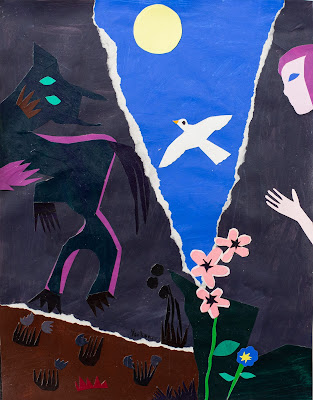
From Ulysses's Journey by Toti O'Brien. www.totihan.net

The winter edition of the Poetry Letter, No. 4 of 2021 started with an editorial and "Rules for Happy Holy Days" by the editor, Maja Trochimczyk, CSPS President. 

It is a wonderful custom to wish everyone all the best for the coming year at least once a year. I also do it for Happy Birthdays. What’s the point of a one-day happiness? It is the whole year that must be blessed with joy, creativity, gratitude, generosity, health and all the good things one can dream of.  With the wishes, I’m sharing with the Poetry Letters’ readers wonderful poems by Judy Barrat, Pamela Stone Singer, Dave Malone, Bruce Gallie, & Jeanie Greensfelder. Previously published, these poetic gems surely deserve to be read again. In one case, we are fixing our own error, with apologies to the poet: “I’m Sorry, Mr. Webster” was published in the California Quarterly 47:3 without its last line. Here it is in its entirety. Daniel E. Blackston whose work was included in the California Quarterly 47:2 analyzed a poem by Marilyn Robertson, “Low Tide,” published in the same issue. We reprinted his reflections in the emailed Poetry Letter, but for the online version, it is not necessary. Poetry is a conversation and this is an excellent example of poets talking to each other. 

~ Maja Trochimczyk, Editor

Half of the issue was dedicated to book reviews, published on this blog on January 1, 2022, and the other half to poems by Judy Barrat, Pamela Stone Singer, Dave Mallone, Bruce Gallie, and Jeanie Greensfelder.

https://www.californiastatepoetrysociety.com/2022/01/poetry-letter-no-4-2021-reviews-of.html


Poems  by Judy Barrat

Judy Barrat has been a writer of poetry and fiction most of her life as a hobby and began presenting her work publicly in Los Angeles several years ago at open readings, as well as at music venues, sometimes with a vocalist weaving a song around one of her poems. She has been a featured poet at several Los Angeles poetry venues and has performed three very well reviewed one-woman shows of her poetry and stories, with musical accompaniment, at The Gardenia Club in Hollywood. Her work has been published in several anthologies, magazines and on-line journals. Her poem “I’m sorry, Mr. Webster…” was  accidentally printed in CQ 47:3 without the last line ,so  it is reprinted here in its entirety.

I’M SORRY, MR. WEBSTER . . .


but I must take issue with your 

authority as to two words you 

deem synonymous which, in my 

view, are not as inter-changeable 

as your famous book professes:


The words I refer to, if your please,

are “naked” and “nude.  At the risk 

of appearing argumentative sir, no 

one visits art houses to view 

famous Nakeds.  


It is the “Nudes” -- those entrancing 

figures of women and men, unclothed, 

baring their bodies that we seek. 


So you see “Nude” is art -- in the proper 

setting and in an improper setting 

which I will leave to your imagination 

“nude” may still be art though it may 

simply be embarrassing or even criminal.


“Naked” on the other hand I think 

is more synonymous with “exposed” 

for “naked” is so much more than 

baring the body.  Naked is devoid 

of the mythic mask one might wear 

to hide the truth of oneself from 

the world -- the pain, fear, shame 

or insecurity.


Oh, Mr. Webster, I have never seen 

some of my friends unclothed and 

may never, but I have seen them 

naked, stripped of the armor and shield 

which enable them through each day. 

I have seen in their eyes unshed tears 

which bespeak hearts that ache with 

the pain of caring too much or, perhaps, 

not enough.


However, sir, I concede that in personal 

relationships, nude is so much more 

delightful when both parties are naked.


~ Judy Barrat

Published in the California Quarterly 47 No. 3, Autumn 2021, 

with last line missing, here added.


THE BEACH

The waves rise and fall 

in undulating swirls.  

I sit in the sand on this 

familiar expanse of beach.

This sand knows all my secrets, 

my past, my now.


I remember how, as children 

we played, you and I; 

laughing, crying, 

growing, changing.  

Only this beach 

does not change.


I see your blue eyes, 

dimpled grin, wild dark hair, 

muscles of your bronzed 

body rippling in the sun, 

as, unaware of your magnificence 

you run into the sea.


The waves roar 

reminding me 

they have taken you; 

I shout to them: 

“I’m here – Take me too”  

as I walk to the water’s edge 

and into the sea.    


The sun is bright;  

icy wetness bites 

my ankles, legs, hips. 

I dive deep into a wave.  

In the turbulent darkness 

I feel you near.


Your voice 

permeates the abyss:   

It implores me

“Reach for the sun, for life”.   

Tossed by the current, 

I reach out in panic 

and break the surface 

gasping in the sun.


~ Judy Barrat  

THE ROAD


I left behind the street of childhood 

to navigate the highway of life,

exchanged dirt of backyard and joy of

sandbox for dust of the open road.


In a haze of youthful exuberance, I 

searched for adventure described in books.


I climbed mountains, crossed deserts,

sailed seas to cities and streets in lands 

far and near; encountered life, both sweet 

and simple, and also shockingly brutal and 

barbaric and stood impotent, in my naivete 

to do more than extend a hand.  But some-

times, only sometimes, that was enough.  


I found joy and generosity in places of dire 

need and deprivation, sadness and 

selfishness in the midst opulence and plenty.   


No longer do I walk carefree, inhaling 

nature’s bounty, but run, frantic, in an 

endless quest for-- HOME, as I mourn

the death of innocence and damn the 

dawn of disillusion.  


On this narrow track of time every now 

becomes then in the blur of contemplation 

of tomorrow.  And while each impediment 

on this path may proclaim: this Road 

Leads Nowhere, I find the fortune 

I believed this trip would provide when 

I or anyone extends a hand because 

sometimes, that’s enough.

~ Judy Barrat


I AM


Once I was a cloud 

afloat in the space 

between there and here; 

I faded into nothingness.


Once I was the earth, 

a blue spec in the universe

orbiting an uncaring sun;

it lost its grip and let go.


And once I was snail on the 

ocean shore, enticed into a 

wave to ride the tides into 

a thousand tomorrows.


Today I am drawn from forest’s

edge into its depths by whisper 

of breeze through boughs, 

a language of rippling grace.


The clean green scent of the air, 

solitude of sunlight through

treetops, splendiferous silence, 

speak karmically to my heart.


I am free simply to be; 

we breathe life to one another, 

the trees and me, and for these 

moments, as never before


       I am,   

             I am,  

                    I AM. 

~ Judy Barrat


From Ulysses’ Journey by Toti O’Brien, 2002. Totihan.net

ME ME ME – A Poem By Pamela Stone Singer

ME ME ME


Tell the King; the fair wrought house has fallen.

No shelter has Apollo, nor sacred laurel leaves;

The fountains are now silent; the voice is stilled.

It is finished.

Oracle of Delphi, 393 A.D.*


rain outside the high school

where I teach students to write poetry

at 3:00 p.m. they pour out of the building as though it were ablaze texting 

friends a few feet away, light years away, in a foreign country


some text over a hundred times a day

sleep with phones beside them as if the phones

were going to plant kisses on their lips


overhead, flocks of geese fly through downpours

a few students take pictures of the rainbow appearing

no one else notices

and there are 300 kids on smartphones, twitter, facebook, taking selfies

who rush from the building as though it were ablaze


i don’t understand this communication that negates 

the soft enunciation of vowels, the closed sound 

of consonants, the origins of I in our alphabet: 


Phoenicians used a backwards z called yod, meaning hand.

Greeks used angular versions of I, changed its name to iota.

Medieval times i became a line with a curl.

Today I stands boldly on a page.


eye, window of clarity in bony sockets of skulls

omniscient, like the Pythia of Delphi

Selli at Dodona who spoke through rustling leaves


imagine life with words only on screens

not feeling pages of books

not reading ancient texts for clarity


when life comes alive with words

I becomes we, me becomes us 

myself becomes the earth


* NOTE:  In 389 A.D., under the reign of Theodosius I, Christian attacks against pagan temples continued. The Emperor ordered all pagan temples closed. Within 20 years the Western Roman Empire fell. For the first time in 800 years no oracular statements were given.

~ Pamela Stone Singer


From Ulysses’ Journey  by Toti O’Brien. Totihan.net


Four Poems by Dave Malone

Dave Malone is a poet and filmmaker from the Missouri Ozarks. These poems are from his seventh volume, Tornado Drill, forthcoming from Aldrich Press in March and available for preorder. Dave can be found online in the usual haunts, particularly Instagram @davemalone. 

WALK IN THE WOODS  

         At once whatever happened starts receding.

                                   —Philip Larkin


Last night I walked the woods

lit by the final moon of the month.


Days don’t count here

beneath the centuries-old pines


where my grandmother took her solace

on hard farm days, passing up 


the washboard or jam-making

for the eternal whooshing 


of the forest as much serenity 

as yearning. 


~ originally published in Spindrift


LEAF BLOWER 


During my morning meditation, the neighbor

begins her leaf-blowing. She’s precise


the way she slides from side to side,

the way she forms right angles


as if acing high school math.

Her noise travels into the hollow


louder than semi-trucks howling

from the bypass. She blows


into blowing into blowing

until a vortex of leaves


half-eaten by mower and storm 

form in the narrows. 


Here is a full sound. Here is

the aum I must have been waiting for.


~ Dave Mallone,

originally published in Midwest Review


HERON 

I startled the great blue heron

when my kayak scratched stones

in the river’s low summer water.

With little effort, like the way

one takes off shoes, the grand bird

flapped long arms, held steady,

until she found the shore opposite me

and slipped into the sycamores

below the bluff. She stayed there

a long time, longer than my life. 


~ Dave Malone

originally published  in Right Hand Pointing  


From Ulysses’ Journey by Toti O’Brien, 2002. Totihan.net


RECALLING LIGHT 


It is the light I think 

I recall. Was it church


or vacation Bible school,

the desks like pews,


when the sun’s morning rays 

ached to rest on shoulders


while the teacher dimmed

at the front, barely perceptible


like God. I remember now

the gospel the instructor ignored—


how the cypress floor danced

with golden dust in its hair.


~ Dave Malone, 

originally published in Right Hand Pointing


From Ulysses’ Journey by Toti O’Brien, 2002. Totihan.net

A Poem by Jeanie Greensfelder

Jeanie Greensfelder’s poems have been published at American Life in Poetry, Writer’s Almanac, and Poetry Foundation’s Poem of the Day; in anthologies: Paris, Etc., Pushing the Envelope: Epistolary Poems; and in journals: Miramar, Thema, Askew, Persimmon Tree, and others. She served as the San Luis Obispo County poet laureate, 2017,18. Jeanie’s books are: Biting the Apple, Marriage and Other Leaps of Faith and I Got What I Came For.  Website: jeaniegreensfelder.com

CALIFORNIA CLOUDSCAPES           


The sky solid blue, your gallery

disappoints. I await the next show. 


Give me a full circle exhibit,

a different artist in each direction, 


a cumulus haven where sun-lit gods

and harp-playing angels lounge.


Surprise me with a Mount Shasta mirage,

a Disney display of dragons and dinosaurs,


or the drama of an El Greco storm, one that

reduces me, puts me in my place. 


Let me study the brush strokes and guess

artists from baroque to surreal.


Show me an orange, yellow, blood-red sunset,

invoking nature’s Edward Munch scream.              


Bring on Georgia O’Keefe puffballs,

Van Gogh swirls over grassland,


even a Rothko mist, but please no grey washes,

those ho-hum shows that go on and on.


~ Jeanie Greensfelder

 published in Birdland Journal 2019


From Ulysses’ Journey by Toti O’Brien, 2002. Totihan.net

Three Poems by Bruce Gallie

Bruce Gallie started writing poetry right after high school and has continued to do so with several long and short hiatus.  He has been in the army, a cook, and an electrician throughout his career. He retired in 2010.  He published many poems in the California Quarterly since its genesis.

PINE

Evergreen last seems long ago

been Christmas scent and scene -

Lucky, old sweetheart, old friend passed

the grains aligned well before the end

                I knew what would be... 

                You softened the roar             

               salvaged the moods,

               when lost in the woods

                your timbre was with

                mine —

                pine, Lucky

                pine.


 ~ Bruce Gallie         


BABY PICTURE

Ol' Sol will rule the roost

in his own steady way

he beams through the evening window

turns the wall gold from gray


the shadow line climbing

to a sepia toned portrait —

an old baby picture

hanging less than straight


the dresser in the corner

lost a knob, a trophy sits on top —

batter at the plate.  There's a vase

with a paper daisy, a Baby Ben stopped


on a bed, a dusty quilt

and old magazines strewn

some Elvis 45's with worn jackets

there's the title: "Blue Moon"


as evening falls, the shadow

crosses that chromatic display

the child's flushed cheeks fade

to the background, hair to gray.


~ Bruce Gallie


From Ulysses’ Journey by Toti O’Brien, 2002. Totihan.net


LAST ROSE OF SUMMER

     ~ thanks to Sir Thomas Moore


"Tis the last rose of summer" Mom would sing to me

"all her lovely companions are left faded and gone"

when I was but five felt kindred to this song

as the years bore me up in a see saw sea.  


With weakness and strength, full of folly and free

spent time in kinship if not more alone.

"Tis the last rose of summer" sing to me

"all her lovely companions are left faded and gone."


With the years wisdom waxed slowly

sure as time erodes the bone.

We fall alone but stand as one -

this is the law that lets us be.

"Tis the last rose of summer "-

sing, last rose, sing to me.

~ Bruce Gallie


From Ulysses’ Journey by Toti O’Brien, 2002. Totihan.net

ABOUT THE ARTIST

Toti O’Brien’s mixed media have been exhibited in group and solo shows, in Europe and the US, since 1995. She has illustrated several children books and two memoirs. Her artwork is on the cover of several books and it was most recently featured in pethricor, Two Hawks, Arkana and Argo. More about her work can be found at http://totihan.net/index.html.

O'Brien is also an award-winning and critically-acclaimed poet and writer of short stories. She published many books in English and in her native Italian. A list of her publications may be found on her website: http://www.totihan.net/writing-resume.html


Saturday, January 1, 2022

Poetry Letter No. 4, 2021 - Reviews of Books by Moomey, Pero & Campion, Lohrum Cotton, and Escoubas


Wine Country by Vera Campion from a dialogue with Alice Pero

Laura Schulkind’s Review 

of Make For Higher Ground by Diane Lee Moomey

Make For Higher Ground by Diane Lee Moomey. Barefoot Muse Press, 2021.  ISBN 9798509619205; 63 pp. $10.95.  http://www.barefootmuse.com/

Diane Lee Moomey is one of those masterful form poets who uses structure to challenge boundaries. Her new collection, Make for Higher Ground (Barefoot Muse Press, 2021), does just that. Throughout, it is evident she has drawn on I Ching #57, Penetrating Influence, which she speaks of in the introduction and riffs on in the opening poem, as the collection both offers us a path to higher ground, and persistently urges us to take it.  

Her path begins with “Small Wild Things”, a group of poems that leads us into the “tall red grasses” that lie just beyond the road. She finds sleek snakes in “the long stems my father’s mower doesn’t/reach” (Wearing Snakes); and imagines wild cats in the forest abutting the golf green (Time Share at the Country Club). In juxtaposing human activity and wildness, she urges that we not forget our connection to the wild—even as we mow and drive and golf and stay indoors with the radio blaring. As she concludes in Chaparral, just knowing “. . .the wild/ is out there. Sometimes/that’s all you need.”

From there, she takes us to our beginnings in a section titled “Tap Roots”— suggesting we can’t get much of anywhere without understanding our origins.  “I’d open trunks and boxes, pry;/so certain that I’d found the place/where all the family secrets lie.” (The Other Attic). The intimate details of these poems (the “wicker chair with yellow chintz/ that curved to her fit”—Her Screen Porch) also convey a loving eye—reminding us that we can cherish where we came from without getting trapped there.  In her exquisite poem, Carousel, she considers her own mother’s choices, and in so doing perhaps explains her own: “You could get off. You may have wanted something/else: the purple unicorn . . .”  

Now grounded, the book offers us Fractals, a series of poems on how to navigate a dangerous world. Here we find perfectly placed at the middle of the book, Water Above Water Below, (a riff on I Ching #29—Danger), which gives us these final lines: “The lamps are going out, dear/one by precious one and it’s for us/to choose to live in darkness or, blind/and trembling, make for higher ground/and set ourselves alight.” 

Then, in the last two sections she shows the way out of the darkness. In Coming Up For Air, the poems remind us to find delight in the world we have—embrace dear friends (“I’ll squeeze Purell into my right/palm and gently stroke your left cheek”); arrange pandemic picnics; rescue “former treasures left behind” from the dollar bins.  

In Lights Above the Poles she adds, and ends with, love. A gorgeous collection full of sky and light, these poems tell stories that remember, long for, miss and sustain love. Importantly, there is nothing saccharin here. Indeed, the last poem ends ominously, “Making coffee, breaking camp—/we do this well together,/but whitecaps, winds and lowered skies; promise heavy weather.” And that’s the point. Higher ground is not a panacea; it isn’t even a place. It is a way of being in the world that Moomey gently urges in this compelling collection.

~ Laura Schulkind

Kathy Lohrum Cotton’s Common Ground reviewed by Michael Escoubas 

Common Ground by Kathy Lohrum Cotton, Deep Well Poetry, 75 Poems, 103 Pages,  $12.00,  ISBN: 97986111359884

As I write this review (late April 2021) President Biden has just completed his first address to a joint session of Congress. Senator Tim Scott has given the Republican rejoinder. Listening to both men recalled poet Kathy Lohrum Cotton’s latest collection, Common Ground. Whether you believe in Providence, Fate, Coincidence, or just plain Randomness, you must admit these ducks fell nicely into a neat row.

Enter Kathy Cotton, stage left. With quiet assurance and ripened poetic skills, Cotton offers a collection of poems which bear directly on what many are seeking. Remarkably, these poems were written “prior” to the advent of Covid-19. Which is to say that her theme is timeless and does not need a worldwide pandemic to justify its existence.

An epigraph by no less a luminary than Walt Whitman, sets the tone: “Every atom belonging to me as good belongs to you.” It is the gift of language that humans alone possess and share. Appropriately, the poem “Finding Common Ground,” opens the door to Cotton’s quest:

Before the extravagant feast,

the flowing wine of words,


let me break bread

at the table of


a neighbor starving

on broth-thin bromides,


elders who chew

old shibboleth scraps,


the child choking down

force-fed fear.


I got the feeling early-on that this poem represents the poet’s life. Helping a person in need is more important that just setting words down on a page. Only then:

let my pen touch

the waiting page,

who stands in rain-spattered pajamas,


breathing, just slow-breathing

in the middle of his wire-fenced yard—

. . .

This cloudburst soaking

his drought-brown garden brought


him from his bed, quick like a child,

wordless with wonder at the scent of rain.


While Cotton writes primarily in verse libre, her skill in formal verse is evident in the villanelle, “Words of Peace”:

There is sweet symmetry in words of peace,

as both the mind and heart communicate—

a balance of withholding and release


through conversation shared: the centerpiece

of knowing when to speak and when to wait.

There is sweet symmetry in words of peace,


not toppled into dogma or caprice.

It chooses not to flatter or berate,

but balances withholding and release


to find a common ground where conflicts cease

to rage alone, a place where pain abates.

There is sweet symmetry in words of peace:


both hope and understanding can increase

when empathy is speaking’s gentle mate.

It balances withholding and release:


a spoken and unspoken masterpiece—

consideration, rather than debate.

There is sweet symmetry in words of peace,

a balance of withholding and release.


Titles in Part I, entice me to reconsider my life perspectives, titles such as: “Quiet Friend,” “Gift of Your Silence-Keeping, “Inner Balance,” and “Slow Thaw,” hang like medals on a service-member’s coat; commendations won on the battlefield of life.

Vera Campion's image from Beyond Birds and Answers dialogue with Alice Pero

Moving into Part II, “Shared Words,” I found myself focused on “The Sweetness of Doing Nothing.” This poem explores the tension between “busyness” as a virtue and Dolce far niente. (Translated in the title). This shared word is one your reviewer needs to hear. 

let the ink’s dark nectar

spill out


every ripened syllable

of words worth sharing.


Stylistically, Cotton does something I’ve never seen before. At the end of many of her poems, she adds key words in a delicate light-face font; subtly  highlight-ing a theme she wants readers to consider.

The volume is organized in three sections: “Quiet Words,” “Shared Words,” and “Last Words.” In an age of loud talk, street and gun violence, and folks insisting that it’s My way or the highway, Cotton’s wisdom is like a warm cup of Chamomile tea slowly sipped.

In my youth I recall how the evenings took on a unique fragrance after a soft rain, Cotton took me back in her poem “The Scent of Rain,” where her old Lithuanian neighbor:

Perhaps I  should emulate the poem’s protagonist and, “stretch full length on a Montana stone.” In this section shared words become “strands of simple kindness, a treasure to pass down.” 

I recall special evenings tiptoeing into my children’s rooms to read stories and say their prayers. The ease of those moments, the quietude of being with them, things we shared before clicking off the lights, returned to me as I entered Part III, “Last Words.” 

I lingered long with “Sweet Cluster” where:

I fell asleep to the lullaby

of a family’s last words

of the day, to soft sounds

of Mother and Father kissing.

Impressive tenderness and restraint. Many of these poems could be read as testimonies to loved ones who have passed on. While platitudes often accompany loss and death, the poet’s treatment is fresh and original. She remembers her brother, the “only shaved face in a little house crammed with petticoats.”  Ed was, “the last of all who knew me from my beginning.”

In “The Last of Life,” death is compared to:

Winter’s longing to shed

the weight of every last leaf,

to stand proudly stripped,

wind-whipped to the marrow,

baring misshapen limb and scar.


The “welcome home”

rivers sing to scattered streams

and oceans whisper

to heavy rainclouds.


The ripple

of a zephyr’s soft breath

across ripened fields.


So, this

is how it feels

to love the last of life.


Indeed, Kathy Lohrum Cotton’s Common Ground, closes with a blessing I wish for everyone who buys this superb volume:

Leave something

of sweetness and substance

in the mouth of the world.

--Anna Belle Kaufman, “Cold Solace”


~ Michael Escoubas

Reprinted from Quill and Parchment


Toti O’Brien’s Review of Beyond Birds and Answers

by Alice Pero & Vera Campion

Beyond Birds & Answers: a Dialogue by Alice Pero and Vera Campion, Elyssar Press, 2021; 78 pages, ISBN:‎ 978-1733452991

Beyond Birds and Answers is a symphony of questions in three movements, varied in color and rhythm, yet unified by thematic elements echoing throughout. Musical in its essence, masterly harmonized, as tightly interlaced as a great jazz impro, this small gem of a book is the joint effort of a poet and an artist so flexible, they evade the confines of their disciplines and create a unique esthetic experience. Words sing, colors and shapes leap and dance, poems spill from the page and create a fluid narrative, single artworks melt into a moving kaleidoscope. 

Artist Vera Campion’s imagery is deceptively simple. At a closer look, her scenes are brimming with mystery. The improbable shape, the daring combination of colors, the hidden, puzzling detail, the curious overlapping. Alice Pero, the poet, doesn’t miss a bit of such complexity. She explores and fully enjoys the labyrinth, unafraid to ask both pertinent and, more importantly, “impertinent” questions—the clear-eyed ones born by a keen, fierce imagination. The art promptly responds.

Guides are there through the journey, different for part one, two and three: birds, flowers, and stars. They are brave, and elusive. As the title imply, they don’t provide answers, only point at new possibilities. Children will feel at ease into the vibrant universe woven by Pero and Campion, but theirs isn’t a children book. For the visual part, we can think of Chagall, Matisse, Klee. The poetry has a surrealist flavor. Verse and figures unfold like a game of Exquisite Corpse, delightful in its sheer unpredictability, yet magically endowed with coherence and meaning.

~ Toti O’Brien


Image by Vera Campion from Beyond Birds and Answers dialogue with Alice Pero

Neil Leadbeater’s Review of Beyond Birds and Answers

by Alice Pero & Vera Campion

Beyond Birds & Answers: a Dialogue  by Alice Pero and Vera Campion, Elyssar Press, 2021; 78 pp, ISBN:‎ 978-1733452991 

The first thing to notice about this book is that it is a collaboration between two people. It is subtitled ‘a dialogue’ and that is precisely what it is. The book is dedicated to the memory of Bob Hart (1931-2014), a New York poet whose work on dialoguing has been an inspiration to Pero and Campion down the years.

Alice Pero has been creating dialogue poems with more than 20 poets over the years. She started dialoguing with other poets as a dancer in the 1980s and these continuing exchanges have resulted in thousands of pages of poetry. Her work with New York City artist Vera Campion is her first conversation with works of art. Pero is a teacher of poetry and a member of the California Poets in Schools, where she has developed a unique style of teaching children poetry based on rhythm and other art forms. She is also a classically trained flutist and formed the Windsong Players Ensemble in 2015 which performs regularly in the Los Angeles area. 

Of Czech parentage, Vera Campion moved to New York in 1970. She studied watercolour with Theo  is and later studied at the Arts Student League with leading New York artist Knox Martin. In the early nineties, she studied Intaglio printing with Veejay Kumar at the Manhattan Graphic Center, New York City.

Campion views her art as ‘Reality in Metaphor’ and is particularly interested in collage as an art form. She likes to see a picture grow organically from cut-up shapes so that the final image comes as a surprise. Her work has been shown in Prague, the USA and Canada. The intense use of colour in her work has prompted comparisons with Henri Matisse, a comparison that she is very happy with. The artwork in this collaboration is full of movement and colour. Her collages of people, animals, birds, flowers and stars evoke a sense of childlike wonder about the amazing world in which we live. Taken as a whole they convey a rich visual vocabulary that is matched with equal force by Pero’s poetic vision. 

The book is divided into three distinct chapters. Each chapter contains 10 poems. The layout of the book differs from the conventional format insofar as there is no contents page, none of the poems have titles and the works of art, which have titles assigned to them outside of the book, are not titled either. The poems and paintings are placed opposite each other so that the reader does not have to turn the page. In the first chapter, the reader is invited to look at the artwork first and then to read the poem. All the poems in this chapter are justified to the left. In the second and third chapters the reader is invited to read the poem first and then to look at the artwork. All the poems in this chapter are justified to the right. This prompts the question: which came first, the poem or the artwork? Intriguingly, we are never told. 

The three chapters are quite distinct. In the first chapter the reader is introduced to the simple image of birds, especially the crow. The second chapter focusses on some of the darker aspects of life including the concept of evil. The last chapter moves towards a spiritual perspective. Here, the image of the star is very much in evidence. Despite the differences, there are common threads that weave their way through the book, giving it a sense of unity and purpose. Magic, movement and colour combined with a childlike innocence and sense of awe, keep the poems anchored while at the same time allowing the reader to use his or her own imagination as well. It is as if Pero is holding her poems as one would hold a kite giving the reader enough free reign to watch the kite fly freely in the wind. 

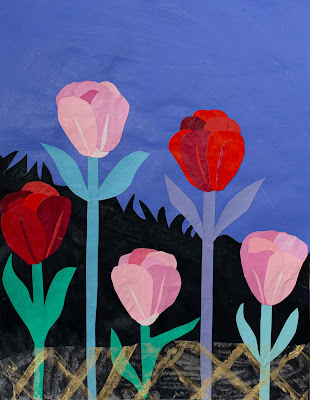
In a review like this, offering the reader an extract is tantamount to offering only one half of the story because the poem should really be seen in conjunction with the artwork. I should therefore explain that this poem is one that is positioned alongside an artwork showing five pink and red flowering tulips standing at different heights against a dark sloping background and clear blue sky. 

So tall and straight

meeting the sunlight

in colors we take in

like whiskey, straight

no chaser


There is no escape

You announce your beauty

with no apology, no safe distancing

We must breathe your air

without complaint

We are not afraid

of beauty

Originally a dancer and a musician before she became a writer, Pero’s poems have a musicality and a rhythm all of their own. This may be one of the reasons why the punctuation is sparse. Only commas and question marks are used. There are no full stops. For Pero, rhythm and the positioning of the line break provide all that is necessary to convey meaning. Some poems begin with a question or a series of questions while others end with a question. All the questions are rhetorical. We do not expect them to be answered. 

Like Campion’s artwork, Pero’s poems are full of birds, flowers and colours. Crows are mentioned five times, the word ‘flower’ is mentioned 18 times and the word ‘colour’ and /or  the mention of a specific colour appears frequently throughout all three chapters of the book. Campion’s predominant colour is blue and that is the colour that is mentioned the most by Pero.

The idea of collage that is portrayed in Campion’s artwork is captured in Pero’s poems in a number of different ways: ‘daisies’ are ‘divided in so many parts,’ somebody falls ‘into a dozen pieces,’ ‘flower heads fall / as though beheaded,’ ‘stars’ fly from someone’s eyes and doves explode, ‘leaping into the sky’. Pero’s phrase ‘an explosion of doves’ is particularly arresting since doves are traditionally viewed as symbols of peace. Like collage, Pero holds these fragments together with her carefully chosen words.

The following stanza is taken from the final chapter. The first two lines reminded me of Holman Hunt’s allegorical painting, ‘The Light of the World’. In direct contrast to that painting, the final two lines startle us with their image. They evoke a real sense of frustration that some people just cannot ‘see’ that there is so much beauty in the world and more to life than meets the eye.

I will knock at his door

of disbelief

and throw a brick

into his consciousness


Tis collaboration is a testament to the power of the imagination. It shows us how art and poetry have the capacity to inspire us. One of the many beautiful things about this book is that it will appeal to all ages. Fully recommended.

~ Neil Leadbeater, 

published in Quill & Parchment and

 reprinted with kind permission.


Karla Linn Merrifield’s Review of Images by Michael Escoubas

Images: A Collection of Ekphrastic Poems by Michael Escoubas, 29 Poems ~ 29 Paintings & Photographs ~  58 Pages, $15. Cyberwit.net ISBN 978-81-8253-761-3. https://www.cyberwit.net/publications/1755

Readers of Quill & Parchment know about ekphrastic poetry which has long been publishing a section dedicated to ekphrasis. The journal is not alone in its spotlighting of the art of poetry written in response to a work of art (which is what ekphrasis is—that simple).  The online quarterly Visual Verse: An Anthology of Art and Words has been solely devoted to ekphrastic poetry for eight years. For each edition, the editors select an image and invite poets to respond to it in much the same way as does Quill & Parchment.

You might even call ekphrastic poetry a rage! In September, my local poets organization, Just Poets of Greater Rochester, offered at its monthly meeting, an ekphrastic workshop conducted by poet Kitty Jospé, whom I’ve longed deemed the guru of ekphrasis. Her many years as a docent at the University of Rochester’s Memorial Art Gallery has inspired Kitty to write dozens of stellar ekphrastic poems. It was Kitty who first introduced me to the genre.

With all that may be said about history, background, and resources of the genre, one can do no better than dive into Michael Escoubas’ Images: A Collection of Ekphrastic Poetry. This work is destined to become a handbook for both beginners and experienced poets who embrace this poetic approach. 

Michael is an accomplished poet of ekphrasis, right up there with Kitty. His new collection (which follows his 2018 ekphrastic journey with Monet, Monet in Poetry and Paint, and his 2019 collection, Steve Henderson in Poetry and Paint) in that wildly popular genre is a stunner. 

Here are twenty-nine poems paired with beautifully reproduced full-color paintings, photographs, a quilt, and even a swatch of embroidery that lead us from image into words woven with flashes of wisdom. In “Sea and Shadow,” based on a watercolor by Blanca Alvarez, Michael observes, “We live in the/ continuous mystery of now.” In “Village by the Sea,” he reminds us to listen to ocean music: “…absorbed in each other/ the caressing of the sea/ is like a song…” And, al-though the poem is based on an amazingly evocative photograph by Victor Riehl, you will see no lovers in the image. That, too, is part of Michael’s ekphrastic genius—he brings something greater to the original work of art! All the while wisely inviting us to experience anew the soothing voice of Earth’s great waters.

The book also offers us welcomed moments of tenderness. Tears nearly sprang into my eyes reading “Ingrid loves white orchids,” after a photograph by Sharmagne Leland-St. John (editor of Quill & Parchment). In the poem a shy teenage boy marks an important passage in his budding love life. About to head off on an important date with a girl, “… he takes a moment to tie/ the orchid around her wrist …” Remember those days? Your first prom? That slender boy who brought you flowers? Or your own boyhood and that significant evening that began with a rose or carnation? Almost impossible not to scan your memories in search of a similar scene, such is the evocative power of Michael’s lines.

What a joy it is to turn the page and be treated to a brief lesson in art history, too! Take the poem “Vibrations of Color,” which reflects on Paul Cezanne’s 1897 painting “Pines and Rocks.” We learn about Cezanne’s realism, and how he “never fit in / with the Impressionists” as well as how he “became the bridge / between Monet and Picasso….”

You needn’t be a denizen of the world’s art museums nor even a reader of poetry to appreciate this collection. There’s something for everyone in Michael’s handsome book. It’s accessible, immediate, absorbing—and delightfully quiet. Art, and the poetry of art, enables healing. Thanks to Michael, a seer and teacher, we may emerge from his pages having come to “love the austerity of ice-blue trees,” as he writes in “The Empty View.” With poet Michael Escoubas in our lives, we need never fear an empty view on life, love, art, and poetry.

~ Karla  Linn Merrifield. Reprinted from Quill & Parchment

Image by Vera Campion from Beyond Birds and Answers dialogue with Alice Pero


Thursday, December 23, 2021

Best Wishes for Merry Christmas, Happy Holidays, and a Wonderful New Year 2022!


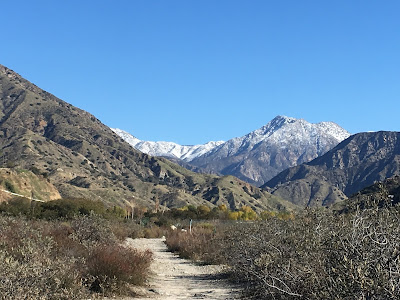
Look! There are seasons in California. Fall turns into winter for a day, and then it is spring.  Today, we have a real autumn rain, with gold leaves falling to the ground, heavy with raindrops. Meanwhile, the narcissus and daffodils have started to bloom - so, is it really autumn? This year, I have not seen the snow yet; the photo is from two years ago from my favorite Big Tujunga Wash, when the sky was clear of striped artificial clouds, and the air crisp and chill.  


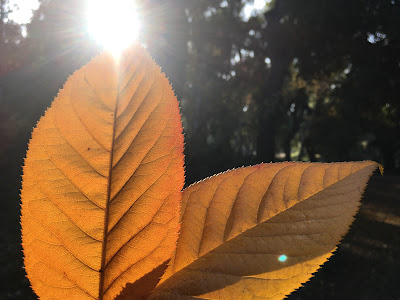
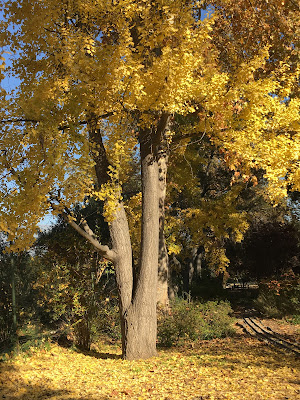
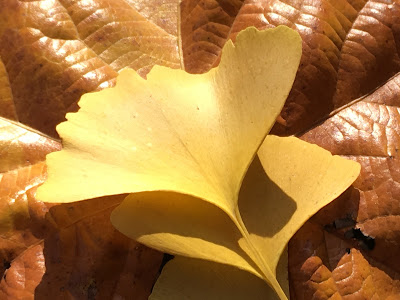
Last year, the monumental gingko tree at Descanso Gardens turned majestic gold. Let this gingko become the Holiday Tree this year for those who do not decorate their Christmas trees, let it shine with the brilliance of  autumn gold through the year of brightness and joy. 


Let us then share our best wishes of all happiness and joy through the holiday season and in 2022. I wish all the great poets and friends of California State Poetry Society and the California Quarterly  the blessings of creativity, inspiration, and delight with life. I would like to share the wishes I received in an email recently from one of our CQ poets. Enjoy!

"May you and yours have a wonderful Christmas and a happy New Year. 

This is the season when small children write cryptic notes to a white bearded stranger in the North Pole, and dream of lighted Christmas trees with bundles of colorful packages underneath: When the elderly dream of past Christmas dinners packed with relatives and children, and those long past times when the air was pure, and masks were only worn during Halloween. 

This is the season when a mystical atmosphere seems to form out of a sense of wonder and want, and a tiny baby in a stable becomes real again: It is a special time when we attend church in the late night to celebrate the coming of a baby who will become a beacon of hope and light

This is the season when a magical atmosphere develops bringing a sense of peace, and wonder to our hectic lives: When we actually wonder if enemies are really enemies, and if there may be a Saint Nick, that brings happiness into the lives of children.

This is the season when tree leaves fly about like young lads and lassies in their bloom: A time when we welcome the blue moisture of rain, and the whiteness of snow upon the earth to tell us all things can change.

This is the season when husbands and wives fall in love all over again, and the future appears brighter: When families get together in gratitude and love, sharing hugs and smiles. 

This is the season we yearn for all year long to do all those wonderful things we should be doing all year long: It is a time when we see each other in a different light, and candles in windows reflect the wisdom of our dreams. 

Thank you for publishing my poems, I appreciate it!"

Peace,

James Piatt (published in CQ 46:3 edited by Terry Ehret)

https://www.californiastatepoetrysociety.com/2020/09/california-quarterly-463-fall-2020.html


Very nice.  I wrote my own reflection on Christmas celebrations as time for family, sharing, and contentment in my wishes to the Helena Modjeska Art and Culture Club, with two older poems I wrote on that theme, so I will not copy those here. You can read them, if you want:

 https://modjeskaclub.blogspot.com/2021/12/merry-christmas-happy-holidays-and-best.html


Recently, I have written a new poem on a related topic of solstice, best wishes, and celebrations, but will include it in my issue of the California Quarterly 48: 1, Spring 2022, so here is another 2021 poem, added to the expanded version of my war-poetry book, The Rainy Bread: More Poems from Exile that I decided to enrich with a positive, uplifting conclusion, since the way out of darkness leads into light. 

http://poetrylaurels.blogspot.com/2021/10/trochimczyks-rainy-bread-more-poems.html


≡ THE ANTIDOTE ≡


Chaos breaks out in our cities full of noise, 

toxins, radiation. I withdraw into my garden,

compress the sphere of attention, 

intensifying the focus on minute details.


The liquid patterns of finches’ song, repeated 

like a broken record. The sediment lines 

on the layered rock from Big Tujunga Wash.

The translucent oval of a quartz stone, 

smoothed by the Pacific on Oxnard Beach.


The imperceptible motion of leaves 

expanding skywards, while their roots 

stretch down invisibly, moist with dew.


Is it not enough to taste a pomegranate,

really taste each tart aril, bursting in your mouth? 

Is it not enough to turn your face up, 

to be kissed by noon sunlight?


“No fear, no hate, not even a slight dislike” – 

says St. Germain. We clear the rubble 

of memories of past pain, stronger, 

more clingy than the pain itself.


The mind is full of useless knowledge.

The body remembers on its own.

Pitiful. The heart locks itself 

in a hard shell of protectiveness.


We have to conquer this chaos within, polish 

the lamps, wash the windows into sparkling 

translucence, letting the light in, clear, 

diamond light – the antidote to chaos.


(c) 2021 by Maja Trochimczyk


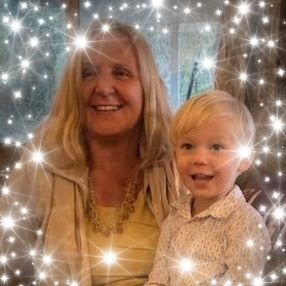
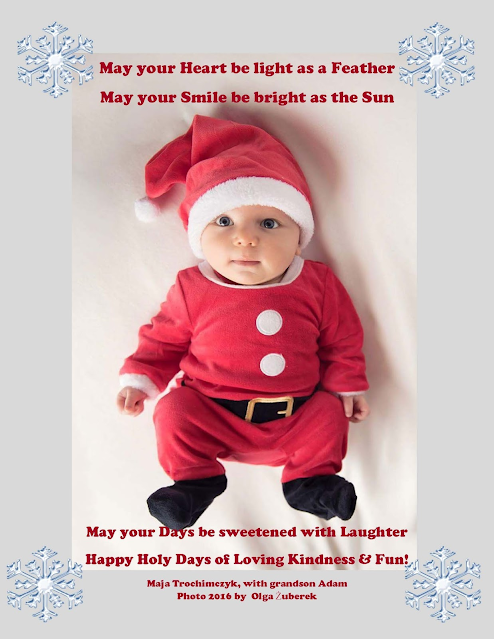
Best wishes for lovely, joyous and peaceful holidays and Happy New Year 2022! Here's my grandson as a baby Santa five years ago. Kids grow up so fast! 


Thursday, December 16, 2021

Contents of California Quarterly Vol. 47, No. 4, Winter 2021, Edited by William Scott Galasso


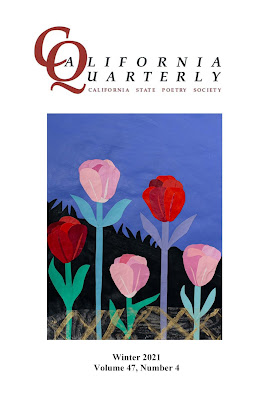
California Quarterly Vol. 47, No. 4, Winter 2021

Edited by William Scott Galasso

Cover Art: Cloudless Sky by Vera Campion, Collage of acrylic hand-painted paper, 11" x 8.5", 2020. From Alice Pero and Vera Campion, Beyond Birds and Answers (Elyssar Press, 2021).


TABLE OF CONTENTS

The Percolation Period  — Thomas Sanford Weir — 7

Memory on a Dream of the Future — Dorothy Howe Brooks — 8

When We Gather — Marilyn Robertson — 9

in creek shallows — William Scott Galasso — 9

An Impulse to Believe — Joan E. Bauer — 10

Left with the Sky — Kevin Thornburgh — 11

seven-year itch — Gregory Longenecker — 11

Birth of Venus — Doreen Beyer — 12

a white heron’s plume — Richard Matta — 13

Union Claire Watson — 13

train trestles… — Richard Matta — 13

So Little Time — Cordelia Hanemann — 14

Painting Moreno Valley — Joel Ferdon — 15

midsummer — Gregory Longenecker — 15

Desert Junk — Richard Nester — 16

Ironic Ashes — Claire J. Baker — 17

Breakthrough — Claire J. Baker — 18

Cartography of a Symphony — Ellyn Maybe —18

Air — Mark Newman — 19

The Size of It — Mark Newman — 20

‘Round Midnight — Joanne Sharp — 20

first notes — Renée Owen — 20

sheltering in place — Renée Owen — 20

The Snail Digger — Linda Kunhardt — 21

Transformations — Kath Abela Wilson — 22

Orca School — Jacqueline Schaalje 23

Hagabat, you bring — Lawdenmarc Decamora — 24

Pagoda of Pots — Paul Willis — 24

garden opening — Kath Abela Wilson — 24

Body Count — Dorothy Howe Brooks —25

Intention — Michael Sprake — 26

Here There Be Dragons — Robbie Nester — 27

Magic Time — Bibhu Padhi — 28

Valve Nutrients — Martha Webster — 29

Leave No Trace — Russell Rowland — 30

Standoff — Diane Lee Moomey — 31

indigo tinctorial — Renée Owen — 31

At a Certain Age It Seems …— Jane Hilary —32

Leavings — John Zedolik — 33

Burden — Marc Fisher — 34

Stitches — Michael Meyerhoffer — 35

Selcouth — Charles Wilkinson — 36

lifestyles of loneliness  — ayaz daryl nielsen — 36

I Am Rooted in the Wind — Lonna Blodgett — 37

Taking Flight — Gary Metheny — 38

sometimes — Gregory Longenecker — 38

Men at Work — Tasha Cotter — 39

the nail he was — William Scott Galasso — 39

New Dad — Danielle Lemay — 40

first marriage — Gregory Longenecker — 40

Night Without Walls  — Margaret Saine —  41

String Theory — Gloria Keeley — 42

A Late September Night… — Gabriella Miotto — 43

True Light — Dennis Ross — 44

The Well — Matthew J. Spireng — 45

my smile — Renée Owen — 45

Tatterdamelion — David Prather — 46

Hollow Bones Haiku for You — Joanell Serra — 47

Moving the Stars — Kathleen Gunton — 48

Pilgrimage — Bibhu Padhi — 49

October Trace  —William Scott Galasso — 49

Geochemistry — Michael Sprake 50

Snowmelt — Marianne Karplus 51

Return — Marc Fisher 52

35th Annual Contest Winners, Comments — 53

Three Men in a Boat — Robert Spich — 56

Snow (a tanka) — Bruce Gallie —57
Rub-a-Dub-Dub, Three Men in … David Anderson — 57

Contributors in Alphabetical Order — 58

CSPS Contest Opportunities — 59

CSPS Newsbriefs 2021, No. 4 — 60

Publishing Opportunities with CSPS — 64

2021 CSPS Donors, Patrons, and Membership — 65

CSPS Membership Form — 67


Image by Vera Campion from a poetic dialogue with Alice Pero.

EDITOR’S NOTE

I’m going to start with what might appear to be an odd choice…a quote by North Carolina’s basketball coach Jim Valvano who was suffering from cancer at the time he made it. I’ve never forgotten what he said: You should do three things every day, laugh, think and cry—because that’s a “full day.” 

As poets we do not merely rearrange words found in a dictionary or thesaurus and call that exercise, poetry. We engage heart, mind and spirit, hopefully expressing ourselves artistically through our shared love of language and a certain musicality. Further, we share a sense of community and a desire to be part of the natural world on a unique and beautiful planet now threatened by climate change and our own counter intuitive will to dominate the very force that gives us life.

Clearly, we live in a complex modern world admixed with light and darkness. One of the elements apparent in the work that follows is that we, in contrast to many, are aware of our own contradictions and in search of harmony. Sometimes we achieve it, sometimes we don’t, sometimes we falter,  sometimes we rise. As editor, I wanted to include poems that were at once topical and of the moment, yet timeless. In doing so, I sought to achieve balance between what we must endure and the inspiration that gives us the strength to do so. 

In addition, I am pleased to introduce work by poets not previously seen in the California Quarterly including Mark Newman, Ellyn Maybe, Richard and Robbie Nester, Gabriella Miotto, Jane Hilary and Mike Sprake and I hope you enjoy their work as much as I do. Further, I take full responsibility for the choices made and have no doubt other editors might choose differently, but it is that diversity that enriches poetry and makes us who we are. 

Finally, it was an honor and a privilege to be given the opportunity to read such fine work. And, frankly, it was a challenging undertaking due to the number of quality poems received. To all the poets who submitted and the staff that guided me in the process, my most sincere gratitude.

William Scott Galasso, Editor 

Laguna Woods, California


WILLIAM SCOTT GALASSO,  EDITOR

William Scott Galasso is the author of sixteen books of poetry, including Silver Salmon Runes published in 2016; Rough Cut: Thirty Years of Senryu and Mixed Bag, A Travelogue in Four Forms, a collection of Haibun, Haiku Sequences, Tanka and Short Poems (2018). His most recent book is Legacy: 30 Years of Haiku (Galwin Press, 2020), described as “a collection of over six hundred poems, ranging from classical nature to personal, intimate haiku… This lifetime achievement stands out as a treasure to stir your senses and heighten your awareness of earth’s nature and our humanity.”  In this book, Bruce H. Feingold writes, “Galasso invites us into a world of quietude, beauty and humility and has mastered the art of saying so much with so few words. His images stand out like exquisite carvings, and he demonstrate[s] the hallmark of great haiku…”

An active member of the Southern California Haiku Study Group, Galasso is the contributing editor of the SCHSG anthology, Eclipse Moon (November 2017).  He holds a Bachelor of Arts degree in English from Hofstra University, and worked for 25 years as an actor for Kim Brooke Group (1990-2015), while also providing event security for Seattle Mariners, Seattle Seahawks and Sounders FC as a team captain, or staff member.  As a volunteer, he supported the Hopelink Foodbank as the coordinator of collection and distribution of donations, also supervising other volunteers, as well as assisting special needs clients, especially the elderly and the disabled.

one breath
the difference between
I am and I was


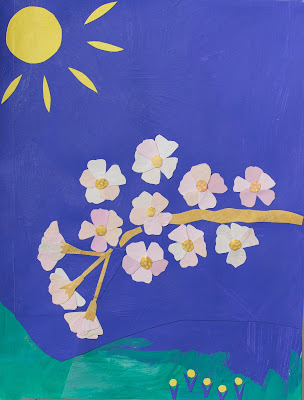
The Journey by Vera Campion from a dialogue with poet Alice Pero.

NEWSBRIEFS 2021, No. 4, Winter 2021

By Maja Trochimczyk, CSPS President

The English language is taking over the world through its versatility and capacity to mutate. Sort of like a virus. Other more complex and stable languages disappear in the fog of time. Let’s look at new words
in Merriam-Webster Dictionary, that publishes short stories about them twice a year, each time adding about 500 words. In 2019, deep state came out of obscurity, escape rooms became a popular form of entertainment, haircut affected businesses losing value, snowflakes became human, yet we relished fabulosity. In April 2020 among 535 new words, we found verbal horrors: deepfake, slow-walk, microtarget, latrophobia, and truthiness. Among the 555 new words in 2021 there are monstrous succubus types, both in sound and meaning (superspreader, deplatform, bit rot), but also amusing ones (teraflop, oobleck), and the beautiful (digital nomad, and amirite for am I right?). The “amirite” – the new mineral of being right… 

35th ANNUAL POETRY CONTEST. We are happy to announce the winners of the 2021 Annual Contest, administered by Joyce Snyder and adjudicated by Georgia Jones-Davis. The contests are judged blindly, the Contest Chair prepares and sends the entries to the Judge. It must have been a surprise for Georgia to find out that the three best poems she selected were written by men! It does not
happen very often, since we have so many female poets; poetry, like teaching and nursing, seems a very feminized profession. 

Prize Winners
  • 1st Prize: “Three Men in a Boat” by Robert S. Spich, Los Angeles 
  • 2nd Prize: “Snow” by Bruce Gallie, Rancho Cucamonga, California
  • 3rd Prize: “Rub-a-Dub-Dub, Three Men in a Tub” by David Anderson, Lincoln, California
Honorable Mentions
  • “Winged Sandals” by Claire Scott, Oakland, CA
  • “A Snake in Pajamas” by Louise Moises, Richmond, CA
  • “I Don’t Know Why” by Livingston Rossmoor, Modesto, CA
  • “Wish” by Susanne Wiley, Hot Springs, AR 
After managing the Annual Poetry Contest for 2021, the Contest Chair, Joyce Snyder, has decided to step down from her role and leave the CSPS Board. Although it happens just once per year, the Contest requires at least six months of volunteer service, so we appreciate Joyce’s hard work since 2016. Thank you so much! 

LIFE MEMBERSHIP. During its October 2021 Board Meeting, the CSPS Board decided to award Life Membership to Margaret Saine in recognition of her many contributions to the organization during decades of volunteer work as Editor, Board Member, and Secretary. The Board minutes stated: “The Board expressed gratitude for the multitude of services offered by Margaret Saine to CSPS and its publications. For many years, she served as the Board Secretary/Historian, Editor of the California Quarterly, proof-reader, Editor of the Poetry Letter, as well as a frequent contributor of translations to the CQ, soliciting submissions from great poets around the world and translating their work from German, Italian, French and Spanish. She also managed the mailbox of the Society (a time-consuming task), sent contributions to other issue editors, and assisted John F. Harrell with mailings of the Quarterly.” The Life Membership means that the Members do not have to pay CSPS dues and will continue receiving our publications. Personally, I am particularly grateful for Margaret’s dedicated and tireless work for CSPS, since she introduced me to this wonderful organization and helped me learn how to edit the CQ and manage the CSPS. 

The CSPS may bestow one Life Membership per year. Our organization, so far, has recognized few other poets with this honor: Gwen Castilli, Torre Houlgate-West, Joyce Odam, Kate Ozbirn, and Russell Salamon who died in 2018. In 2019 we recognized the distinguished Los Angeles poet Suzanne Lummis as our first Honorary Member.  

AMENDMENTS TO CONSTITUTION AND BYLAWS. The distinction between Life and Honorary Membership was finalized in the Amended Constitution and Bylaws, that were approved by all Members after a long editorial process initiated by the Board in 2019. Most of the amendments correct the language to adjust it to the actual practice, like changed dates for Board meetings  and elections, or expanding the number of CQ Editors to a maximum of eight (we currently have four Editors, so we have ways to go!). There was information about the CSPS no longer mailing the Newsbriefs, Poetry Letters, or NSFSPS Strophes that used to be inserted into each issue of the CQ. Another item was to formalize submission requirements, raising the limit from five to six poems. 

The first new idea in Amended Constitution and Bylaws was the separation of Life Membership from Honorary Membership in the Article III of the Constitution, as follows: “a) Subject to the approval of the Board, one Life membership per year may be bestowed upon an outstanding person who has made substantive contributions furthering the purpose of the CSPS. Life Members shall be exempt from payment of dues. b) Subject to the approval of the Board, one Honorary membership per year may be bestowed upon an eminent poet to honor contributions to poetry in California. Honorary Members shall be exempt from payment of dues and are invited to contribute poems to the CQ in the year of their recognition.”

The second new idea in Amended Constitution and Bylaws was the removal of the position of Editorial Chair that had duties overlapping with that of the Managing Editor. Instead, the responsibilities of the Managing Editor are described in detail. The Managing Editor oversees the production, publication, and
distribution of the CQ, and all tasks associated with this process. The President may also serve as Managing Editor with the Board approval, as is currently the case. The confirmation of this role is scheduled every two years. 

CSPS ELECTIONS. The bi-annual CSPS Elections of Officers took place in October 2021 and the ballots included option to approve these Amendments, the full text of Amendments, along with original versions. The Amendments were approved by 100% of voting members that returned their ballots. Amended version of our Constitution and Bylaws will be posted on our website.  The CSPS Elections confirmed the currently serving CSPS Officers for the next two years, to the Fall of 2023:
  • President, Maja Trochimczyk, 
  • Vice President/Communications, Richard Modiano; 
  • Vice President/Membership, Richard M. Deets; 
  • Secretary/Historian, Ambika Talwar; and 
  • Treasurer John Forrest Harell. 

We thank CSPS members for entrusting the Society to us for two more years.

CQ EDITORS. When I joined the CSPS Board, there were only women serving as the CQ editors. I decided to add some younger men of diverse backgrounds and as a result we now have three new editors who have published their first issues of the CQ: Bory Thach (a Cambodian refugee from Vietnam, U.S. veteran with an MFA) edited No. 1, Konrad Tademar Wilk (Polish bilingual poet, grandchild of Righteous among Nations) edited No. 3, and William Scott Galasso (a “refugee” from Seattle, author of 16 poetry books) prepared for print the CQ No. 4. It has been a grand adventure to work with them and read the poetry they selected.

THE POETRY LETTER. In the world of words, poets are digital nomads and our journeys take us far and wide. In 2021, I started sending the Poetry Letter to our email list, so this quarterly publication of poems and book reviews has expanded its reach – in addition to being posted on our website and in sections (book reviews and poems separately) on our blog, californiastatepoetrysociety.com. In its previous incarnation, edited by Margaret Saine, the Poetry Letter was printed and inserted in the California Quarterly mailings, along with the CSPS Newsbriefs and the Strophes, the NFSPS newsletter, now available only on NFSPS website.

PUSHCART PRIZE 2022 NOMINATIONS. Finally, the editors of California Quarterly selected six poems published in 2021 for nominations to the Pushcart Prize, a tradition of small presses and poetry journals. You can read these poems on our blog.
• Vol. 47, No. 1: Sheer Optimism by Lavina Blossom and Blue Fantasia by Ruth Holzer
• Vol. 47, No. 2: Providence by Diana Donovan and Tree Songs by Dana Stamps II
• Vol. 47, No. 3: Quantum Birds by Ida Marie Beck
• Vol. 47, No. 4: Intention by Mike Sprake

https://www.californiastatepoetrysociety.com/2021/12/the-pushcartprize-nominations-from.html. 

Congratulations to all the poets!

~ Maja Trochimczyk, CSPS President
 

Image by Vera Campion from Beyond Birds and Answers dialogue book with poet Alice Pero


Wednesday, December 1, 2021

The Pushcart Prize Nominations from the California Quarterly 2021


The editors of California Quarterly published in 2021 - Bory Thach, Maja Trochimczyk, Konrad Tademar Wilk and William Scott Galasso have selected the following poems for nominations to the Pushcart Prize, a tradition of small presses and poetry journal publications. 

Vol. 47 no. 1: Sheer Optimism by Lavina Blossom

Vol. 47 no. 1: Blue Fantasia by Ruth Holzer

Vol. 47 no. 2: Providence by Diana Donovan

Vol. 47 no. 2: Tree Songs by Dana Stamps II

Vol. 47 no. 3: Quantum Birds by Ida Marie Beck

Vol. 47 no. 4: Intention by Mike Sprake

The nominated poems are reproduced below.  Congratulations to all the nominated poets!


CALIFORNIA QUARTERLY 47 NO. 1
EDITED BY BORY THACH


BLUE FANTASIA


Blue that dwells in larkspur and iceberg,
in herons, little and great,
in swaying lupine, and wood thrush eggs
nestled on the forest floor;

on the magisterial covers
of the Oxford English Dictionary
and in faded hydrangea petals
pressed between its pages;

in first prize ribbons,
copper sulfate crystals 
and the iridescent wings
of the morpho butterfly.

The hue of lobelia and gentian,
of faceted sapphire,
wild chicory at summer’s end 
and juniper berries in fall,

is the color of mussels clattering in a bucket,
not dreaming of steam, of eyewash cups,
varicose veins, surgical scrubs,
cigar smoke, gas flames, exhaust;

the color of the policeman’s uniform
and his cruiser’s flashing lights;
of bruises, winter prisoners,
the eyes of their guards, tattoos.


Ruth Holzer
Herndon, Virginia


SHEER OPTIMISM


All endings temporary.  The very idea
shunned.  Pauses become the new edge,
more fender, cushion, and curve, so that
the minute and second hands swerve slowly
and always return.  What were once breakdowns, now
commas, naps, momentary gaps in a sub-category
of continuum.  Words like
death, fail, cease, redefined to synonyms of
seam, open shining doorway, soft lifting kite.
 
Consternation become akin to
mixing bowl, with an alternate meaning
of swirling multi-colored lights.  And dread
conveying a type of shivering that warms.  All
prophesies, except those that equate with
everlasting joy--gathered up and tossed.  Zero
re-assuming its role as place-holder for those
vacationing, still in touch.  Done, done with.
Loss, a beloved pet, ever young.  Gain
and renewal, inevitable as the rising sun.
A chorus not unlike birdsong or bees
foraging, joined by hopeful amens,
hope having been raised up
many rungs to become far less
tentative, much nearer to certainty.


Lavina Blossom
Riverside, California


CALIFORNIA QUARTERLY 47 NO. 2
EDITED BY MAJA TROCHIMCZYK


PROVIDENCE  
 

This evening when you were tuning your guitar
and the dog began to howl from his spot on the Turkish rug 
I drifted back to our grad school days in Providence
 
before everything started coming down—the Berlin Wall
the Twin Towers—each memory a burst of color
our pale pink Victorian on Hope Street
 
the lavender mailbox with its duct-tape roof
the flock of escaped green parrots on the telephone wires
their bright hues flashing, rising into an indigo sky
 
and the yellow velvet couch on the porch
beckoning neighbors to stop by with tomatoes and lettuces 
from their gardens, musical instruments, and bourbon
 
those warm summer nights before grievances had hardened
when the world was ripening before us
and anything—everything—was still possible.


Diana Donovan
Mill Valley, California


TREE SONGS

Alive, the California forest knows
how to orchestrate itself, curate, permeate, and germinate,
a permanent, sly installation,

yet every faithless flower has reverence for the air,

and I would swear an oath, John 
Clare, that I’ve heard the voluptuous trees sing, members
of the adagio Earth Choir,

contributing with the birds, frogs, a great hawk ballet,

and this music is a per diem Art work, naturally
I listen, agog, in Yosemite to redwood General Sherman’s arias, 
and others, nameless, participate, too, 

and the forest invites this bohemia, this perfection 

of trees, and I know if I were undeniably one
of them, strong rooted, I’d sing to cultivate an audience stand-
still … in bluesy Gaia’s auditorium.


Dana Stamps II
Riverside, California


CALIFORNIA QUARTERLY 47 NO. 3
EDITED BY KONRAD TADEMAR WILK


QUANTUM BIRDS


It lies beneath.
You get to it by digging
to the drumroll of hummingbird wings.

I sought it deep
in the quantum realm, the wave

function, the answers


to the galaxy of starling murmurations,
to the kotuku in that faraway lagoon,
an apparition in nebulous plumage from the spirit land.

That elusive oracle tells all the truth, but slant,
metes out mere probabilities
to even the most meticulous mind,

entangles me in the duality of
defeat and awe.

But a bird is greater than the sum of its parts
 
—the bluebird that fashions his cloak
from a piece of sky, the green heron
stealing a ray of sun to iridesce between the reeds.

In the quantum world, a bird
may be alive and dead.
There is no certainty.

When you cage one truth,
the others fly.

Still, the sandhill cranes will alight
on the river basin
and start to dance.


Ida Marie Beck
Livermore, California


CALIFORNIA QUARTERLY 47 NO. 4
EDITED BY WILLIAM SCOTT GALASSO


INTENTION


I have traveled all the way to the rainforest
hoping I might capture some of it 
in line and color. I watch distant thunder clouds 
sweep across the tree canopy until they reach me. 

In the humidity, watch tree branches laden with orange flowers 
become engulfed with strange birds, 
while a hoop-skinned snake sidles its way 
past the indigenous-wood door, flicking its tongue.

Weeks have passed since I first arrived,
the painting set and empty sketchbook remain 
as if held by a tenfold gravity to the pine-top table.
The idea of picking them up and simply walking 

to the edge of the garden where the wilderness takes over, 
is overwhelming. This might have been how artists 
felt who accompanied Darwin to the Galapagos, 
or Amerigo Vespucci to the New World.

But they with pen and ink, gouache and watercolor
brought back images of unfamiliar flora and fauna, 
the lay of the land, something of the people. 
And I’m running out of time, next to this unfamiliar world 

luring me with its beguiling perfumes, its racket of unfamiliar birds,
this unknown nature breathing within its own body -
this symbiotic place that I find so hard to disturb -
this place should I enter, will be changed forever.


                          Mike Sprake                                                                                    
                          Costa Mesa, California


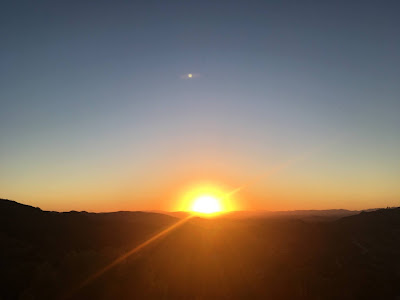
California sunset photos by Maja Trochimczyk