
Showing posts with label Escoubas. Show all posts

Monday, October 9, 2023

CSPS Poetry Letter No. 3, Autumn 2023, Part I - Reviews of Books by Kolodji&Kitakubo, Turco, and Sheibli&Pieczka

Photo by Iga Supernak

A HARVEST OF BOOKS POEMS AND PHOTOS

n time for the fall harvest—a crop of great poems and three book reviews. [...] The three book reviews present Distance by Deborah P Kolodji and Mariko Kitakubo (reviewed by William Scott Galasso), Shimmer: An Ekphrastic Poetry Collection by Paulette Demers Turco, reviewed by Michael Escoubas, who also reviewed Gathering Sunlight by Silvia Scheibli & Patty Dickson Pieczka. Our illustrators are photographers Beverly M. Collins (whom we know as a poet often published in the California Quarterly and elsewhere), and Iga Supernak, both based in the Los Angeles area. 

Maja Trochimczyk, CSPS President

WILLIAM SCOTT GALASSO REVIEWS DISTANCE by MARIKO KITAKUBO & DEBORAH P KOLODJI

Distance. Tan-ku Sequences and Sets by Mariko Kitakubo and Deborah P. Kolodji, Shabda Press, Duarte, CA www.shabdapress.com. 2023, 93 pp.$18.00 U.S (softcover), print 2023932505, ISBN:978-1-7377113-6-0 

Deborah P. Kolodji is the longtime Moderator of the Southern California Haiku Study Group, a member of the board of directors for Haiku North America, and the inaugural recipient of The Science Fiction & Fantasy Poetry Association’s Presidents’ Lifetime Service Award. In addition, her highway of sleeping towns haiku poetry collection was awarded a Touchstone Distinguished Book Award from The Haiku Foundation.  Mariko Kitakubo of Tokyo, is renowned for seven tanka collections, three of which are bilingual Cicada Forest, On This Same Star, and 2016’s Indigo. Needless to say, given their combined literary pedigree, their collaborative work Distance sets a high bar concerning one’s expectations. 

Fortunately, Distance, subtitled Tan-Ku Sequences and Sets (for tanka and haiku), not only meets but exceeds these lofty expectations. These longtime friends, one might suggest (twin daughters of different mothers) have esteemed one another’s work for years. Each sharing their work and experiencing travels back and forth from the U.S and Japan between 2007-2019. 

Then the pandemic struck and most conversation frequently expressed in verse (haiku by Deborah and tanka by Mariko), became their modus operandi. The first of seven sections, we hold virtual hands illustrates how these gifted poets formulated their dialogue. One would text, the other would respond and bridging the time and distance between them literally and figuratively. They did more than cope with different time zones, they excelled in creating unexpected connections. 

The still waters of their call and response formula regardless of the specific subject matter inform each other and grow with each reading. Each of the seven sections is distinct in focus, yet they achieve synchronicity when considered as a whole. Here are some samples of their sets and sequences. I’ve chosen shorter pieces (primarily the sets) as examples due to limitations of space. However, the reward of reading the sequences contained this work is equal in terms of consistent quality.
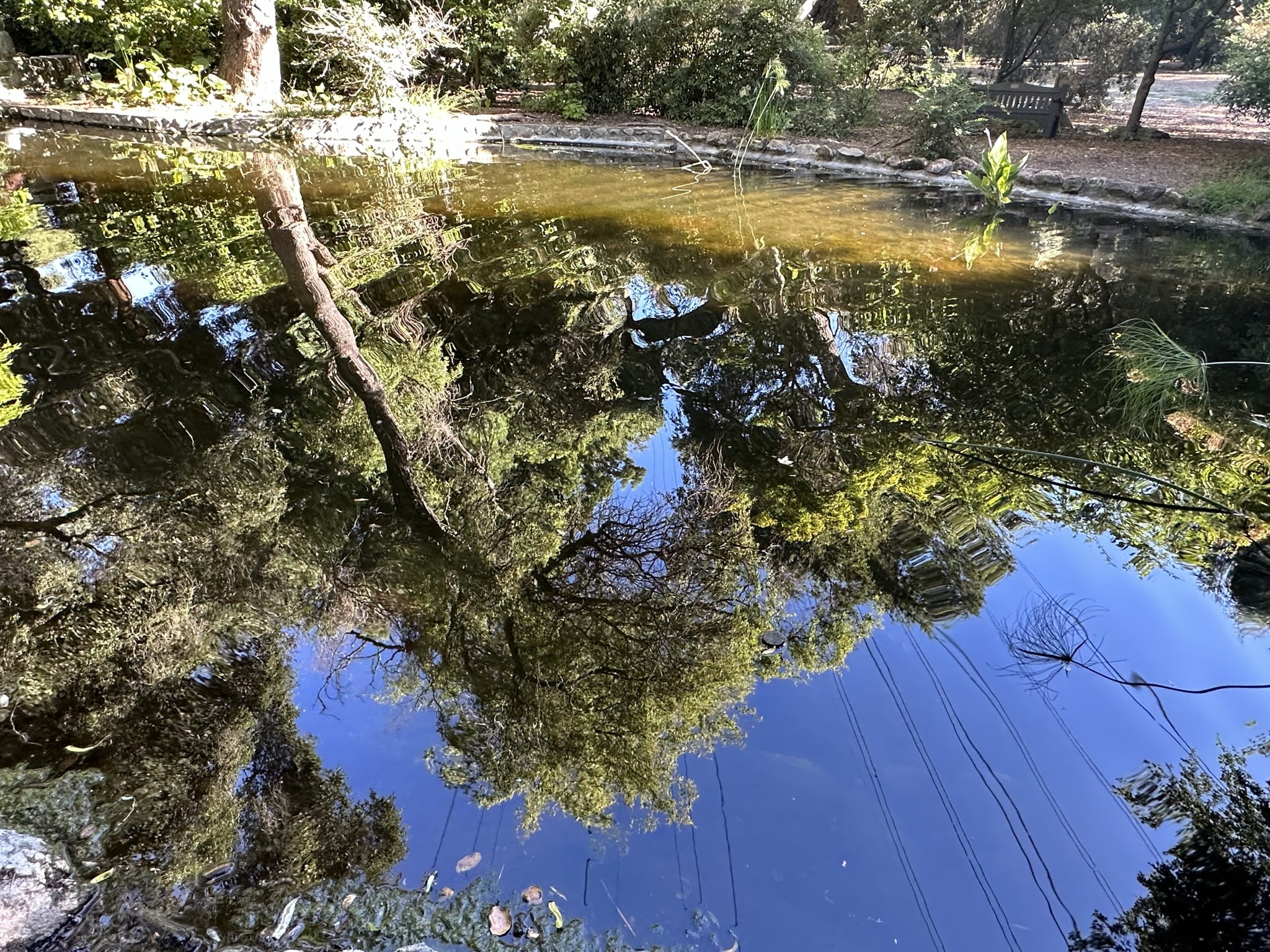
Photo by Deborah P Kolodji

This piece is from the initial section, we hold virtual hands:

                                    Connecting Souls

                                    there is 

                                    an invisible thread

                                    between us…

                                    quietness of

                                    the pearl oyster


                                    closing my eyes

                                    I see your face

                                    Vermeer’s earring


And this from the second section the eternal wind focused on Deborah’s battling illness:

                                     Cancer

                                     wind will bring 

                                     the summer storm

                                     my garden

                                     bordered by living

                                     cadmium yellow


                                     wild mustard

                                     growing out of control

                                     clinical trail 


 And section three presents us with a classical Japanese reference:

                                      Forest Bathing

                                      uphill path

                                      I slow down to breathe

                                      the pine scent


                                      she perches

                                      at the edge of                                                        

                                      my straw hat

                                      a butterfly’s siesta

                                      in emerald breeze

Each section gives us a deep sense nature’s healing power and inherent beauty, a part of Gaia’s treasured gift to us, her children. Hence, reminding us of our own responsibility as stewards of the earth. Here are two more samples that conjure two very different strands of the emotional spectrum the first derives from traces of us, the second from the section entitled my words drift.

Photo by Deborah P Kolodji

                                       End of the Tunnel             

                                       no one knows…

                                       I escaped from 

                                       his violence 

                                       silent night

                                       holy night


                                       no more scarves

                                       to hide the bruises

                                       New Year’s resolution


In contrast with the celebratory…

                                       9th Inning

                                       losing streak

                                       the crack of his bat

                                       hits a foul ball


                                       every motion

                                       stops and restarts

                                       slowly…

                                       we catch our breath

                                       Gyakuten Sayonara!


The final line means “coming from behind,” a “goodbye,” a homer with the bases loaded that give a team the lead. 

Photo by Deborah P Kolodji

Finally, I would be remiss not to include a sequence, from as the road bends: 

                   First Blanket


                   behind

                   pale cloud face

                   the dignity

                   before perfection

                   chestnut moon


                  waiting, waiting

                  the slow rise

                  of the sun     


                  previously…

                  what do you

                  remember?

                  smiles for the sky

                  newborn baby


                  first blanket

                  your face peeking out

                  from its folds                                                                                                                                                       

This collection Distance is full of quiet beauty and a wide range of subject matter comes Highly Recommended.

~ Book review by William Scott Galasso,

 author of Saffron Skies


MICHAEL ESCOUBAS REVIEWS SHIMMER BY PAULETTE DEMERS TURCO

Shimmer: An Ekphrastic Poetry Collection by Paulette Demers Turco. 24 Poems ~ 25 art images ~ 81 pages.  Kelsay Books. ISBN: 978-1-63980-317-0.    ISBN: 978-1-63980-333-0

Shimmer, by Paulette Demers Turco, excels on two fronts: First, it is a superb work of art; second, and perhaps more importantly, it is a work of the poet’s heart. Turco’s professional resume  includes a career in both clinical and academic optometry. Her  life has been about vision, about helping people see the world with clarity. I have no idea whether Turco associates her career endeavors with her art. What stands out to me is Paulette Turco’s visual sense with both brush and pen. My goal in this review is to juxtapose both the “art” and the “heart” accomplished in Paulette Turco’s latest collection.
          
Design — The book is organized into six sections: I. Waves, II. Wishes, III. Flight IV. Flow, V. Beacons, and VI. Home. These economical section headings add to the charm and simplicity
 of design. Each heading contains between three and five poems. The book stays within its prescribed lanes. That is, both design and content are like a well-trained athlete: no fat or flab, just energy and precision.
       
Nuances in Forms — Most of Turco’s poems rhyme. This is a  maturated skill. I found the music of her rhymed sequences delightful to the ear. Even her non-rhyming poems resonate with internal rhymes together with excellent end-line decisions; all strong compositions. Shimmers features four triolets, numerous sonnets and even a double-sonnet. Her free verse poems remind me of Emily Dickinson’s style, particularly in her use of the em dash.

Heart and Art Juxtaposed — I lead with Shimmering Plum Island Dawn, the collection’s title poem. It is one of several triolets which the poet judiciously places within the whole. Triolets feature prescribed line-repetitions and rhyme-schemes. These spare poems pack a creative punch while leaving room for expansive sounds and visual effects. I felt “time” melting as if I were present as the tide came in, castles disappearing. Is the poet’s heart conveying a subtle life-lesson?                                                         

Shimmer, Acrylic on Canvas

Shimmering Plum Island Dawn

Sunrays shimmer in the air,
Time melts as foam-topped waves crash down
on sparkling sand as on a dare.
Sunrays shimmer in the air.
At high tide, castles disappear.
My child’s towel becomes a gown.
Sunrays shimmer in the air.
Time melts as foam-topped waves crash down.

In section II, the poet turns her attention to family. I sense her heart in these poems which feature a young girl’s aspirations for ballet. Visually challenged, the youth must cope with whether to wear eyeglasses on stage. Two graphite drawings of a ballerina’s feet combine perfectly with sonnets that chronicle her inner conflict.

In the same section, the artist draws February Lilies, a combination which offers valuable insights about Turco’s artistic process:
                                                                   
Sepia ink on Bristol paper

February Lilies

Lilies in a vase,
lit with morning light
through a mullioned window,
beside drawing paper
with pen and ink supplies

to try—one stroke, then more,
strong and gentle, curved.
Accentuations, shadows
extend across a sheet
of thick white Bristol paper.

After a quiet hour,
lines transform to stems,
leaves, alabaster
blossoms, vase, translucence—
fragrant scent of spring.

Section III. Flight, features color photographs of sand dunes, ice-glazed holly berries glistening red, waiting for, “cedar waxwings / flitting in, / grasping orbs, / crisp and sweet, / sharing in pairs, / beak to beak.” You won’t want to miss the other lovely images and poems in this section.


Those who love lighthouses will delight in an entire section devoted to them. Orange Sky on Charlevoix is among my favorites:

Orange Sky on Charlevoix

She never could imagine this Great Lake,
illuminated by the setting sun,
bright as a centenarian’s birthday cake—
candles all aflame. This day’s not done.
This lighthouse, water surface, cloud-filled sky,
capture this slant of light for moments here—
before the lighthouse beam will blink its eye,
as if afloat, for mariners to veer
their ships around threats hidden by the night.
For now, the miracle of waves of light
meanders through the surfaces she’ll view
without him—pleased to be among the few
to capture this collage of orange red.
It will not last, nor change what lies ahead.
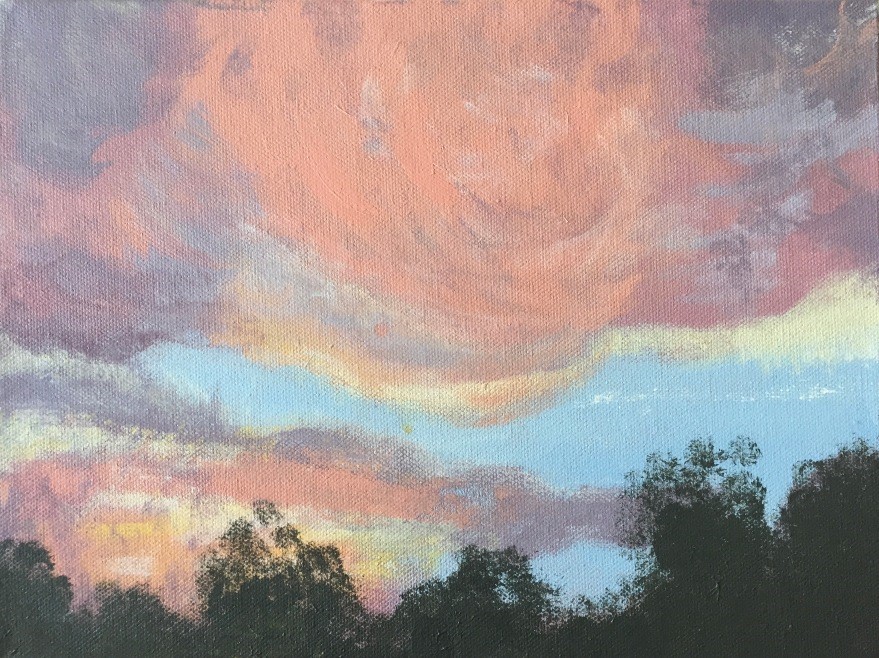

 The term “Ekphrastic” derives its meaning from a Greek root meaning “Description.” However, there is more to it than mere description. At her best, the ekphrastic poet pours her heart into description. After the Lightning Storm speaks volumes:


After the Lightning Storm

Thunder shakes the air, the ground, the oaks,
as bulging, smoke-gray clouds spew giant glops
that soak the withered garden-yellow sundrops,
while jagged light from cloud to cloud now stokes

fear among some families. We help coax
some to shelter with their beach bags. Shops,
though closed, are havens till the lightning stops,
the gusting northeast wind abates. Like strokes

of brush, the late day rays are swept through mist,
lightning clouds that fill a brightened sky
with purples, pinks, and apricot, and gold,
while tall oaks appear as silhouettes
in filigree—surreal to the eye—
a bold celestial canvas to behold.

I close my review, as the author does, with her acrylic 
on canvas creation: Dusk in Marblehead Harbor. 
The curtain falls ever-so-gently with this excerpt 
from Turco’s sonnet, “On the Edge of Light,”:

The harbor surface holds the rim of day,
Reflected in each ripple, every ray
Remaining in an iridescent sky,
Dimming as a gull or term coasts by.


Excelling in both brush and pen, in art and in heart, Shimmer: An Ekphrastic Poetry Collection 
shines with excellence.

                                                                             ~ Reviewed by Michael Escoubas


MICHAEL ESCOUBAS REVIEWS GATHERING SUNLIGHT BY SHEIBLI & PIECZKA

Gathering Sunlight by Silvia Scheibli & Patty Dickson Pieczka  104 Pages ~ The Bitter Oleander Press ~ ISBN: 978-1-7346535-7-1 To Order: www.bitteroleander.com or www.spdbooks.org

In Gathering Sunlight, two poets from divergent backgrounds and contrasting styles, combine their skills. The result is an engaging and wise collection which sheds fresh light on the human condition. The book is all about the hard work of “gathering.” Scheibli and Pieczka, have something to say. 
They are realists. Their poems face life with all its challenges, failures, and sufferings. Poetry is a sanctuary of sorts. Poetry can and should be enjoyed for its magic show of language. However, I hasten to point out that poetry, for Scheibli and Pieczka, is also useful. My goal in this review is to share the harvest Gathering Sunlight has had in my life. 

Backgrounds — Among the standout features of Gathering Sunlight are interviews with each poet by the publisher The Bitter Oleander Press, (BOP). Digesting these educational interviews prior to reading  the poems increased my enjoyment. From the interview I learned about Scheibli’s love for tropical areas of Mexico and Ecuador. I learned that she is an avid “birder” having compiled a listing of over 500 exotic birds during her intercontinental travels. I learned about a real-life mystical figure named “Chakira,” whose influence permeates much of Scheibli’s work.

Patty Dickson Pieczka’s interview with BOP is no less interesting and brings out both similarities and differences between the two artists. “Beyond These Poems There Be Dragons,” introduces Pieczka’s superb contributions to Gathering Sunlight. I was fascinated by her response to why she chose those particular words. Additionally, Pieczka like Scheibli, is a woman of the earth. She spends time in Shawnee National Forest near her native southern Illinois home. She avers, “Nature has always been important to my sanity and spirituality and is often woven throughout my poetry.”

My favorite part of the interviews is when each poet discusses her unique views on the writing process. I found their practical insights helpful.

 Diamond Net, Photo by Iga Supernak

Poems by Silvia Scheibli. Part I—Duende poems

Chakira, tell me once again

Oh, tell me how the moon
opened your eyes and showed you
a change in consciousness

How you wished that every coyote
should have a black-tipped tail

How the oriole’s hood
was dark until you changed it
to reflect indigo sunlight

Nothing appears natural now—
Now you dream the raven in silver.

How do you dream only in silver, Chakira?

Spanish poet Federico Garcia Lorca has described the duende form “as a force not a labour, a struggle, not a thought.” Further via Lorca, duende is “an upsurging, inside, from the soles of the feet.” The duende, new to this reviewer, allows the muse to basically take over and drive the poem. One more example:

 
Seascape in Blue, Photo by Iga Supernak


My friend, Chakira, gave me her chisme  
                            
“Listen,” she said.

Pelicans glide on wings
as straight as paddle-boards.

Aero-dynamic frigates ascend
immense, azure skies.

Supplicant, boat-tailed grackles
seek verdant, queen palms.

Caffeinated kiskadees
exclaim an immanent sunrise.

You need to visit Nayarit—
opaline goblet of barefaced dreams—
more often.

             Editor’s note: “Chisme” is Mexican slang for gossip.

Such is the mystical nature of much of Scheibli’s work, utilizing as it does, tropical surroundings, feathery creatures and an innate capacity for dream. In all, twenty-five poems comprise this section with titles that drew me in: “Ode to Iguanas in Nayrit,” “Jaguar Crossing,” “Under the Palapa,” and “Song of the Orange-fronted Parakeet.”

Photo by Iga Supernak

Part II—Ecuador Poems

Without a doubt Silvia Scheibli loves the people of Ecuador. This hospitable land with its “lush corn fields & many-colored roses, / ruby bromeliads & golden bananaquits, / scent of cocoa & coffee plantations” holds a large fragment of her heart. Six poems comprise this section. “Echos on the Road to Babahoyo,” reveals the poet’s heart for the land and its people:

Geese & dozens of jungle chickens
scratch endlessly on hillsides
of banana trees.

Escaped sugar cane & emerald mist
engulf abandoned houses.

Bromeliads perch on telephone wires
like mourning doves.

With partially opened wings
black vultures cast a shadow
over yellow hibiscus.

Delicate roof ferns
volcanic rock & golden bamboo
fade into midnight
with our café
con alma socialista.

Poems by Patty Dickson Pieczka: Beyond These Poems There Be Dragons

Like a child, I’m captivated by dragons. Pieczka “Had Me From Hello,” with her title poem which I share in full:

Drifting on an ocean’s
silk and shells, sea-foam
lacing pearls along the shore,

I follow a dream back
to its home in the dark,
unlace the night
to find forgotten things:

half-vanished thoughts, time
curled within my roots,
words melted by a long-ago sun.

I drift to the ceiling
to watch you sleep.
Your dream breaks
over shoal-bound rocks,


shaking loose a school
of silver fears
and familiar strangers

who sail angel-winged ships,
read the 16 points
of a wind rose to navigate
through the moon’s veil

and ghosts of fog
to the farthest edge
of the subconscious.

                                                              
 Unity by Iga Supernak
I found, within the dreamy cadences of alternating tercets and quatrains, challenges to my conventional ways of thinking. Did I note above that poetry should have an element of practicality? Gently, the poet prods me to probe life “to the farthest edges / of my subconscious.”
       
Pieczka’s poems are preceded by a quote from Dante Aleghieri: Nature is the art of God. With that as a baseline, the poet skillfully weaves nature and human spirituality into a seamless and coherent whole. Her practical mind gifts readers with down-to-earth titles: “Misplaced” is about her father’s question which indicates that he does not know his own daughter. He asks, Who I am? With a family member suffering from Alzheimer’s, this poem speaks to me where I live.
       
A distinctive feature of Pieczka’s work is the “linked poem.” These poems utilize the last line in the previous poem as a springboard to the following poem. This formulation, as far as I know, is unique to Pieczka. At least, this reviewer has not encountered it before. There are a total of four linked poems in the collection; each superbly conceived and written.

Pieczka’s final poem, “At Horseshoe Lake,” shows both the mind and heart of a poet at the height of her craft:

I pull sunlight from your hair
to make our shadows pour
into the cypress swamp,
where rivulets spill back
to the time we met.

Tupelo leaves brush the colors
left by secrets barely whispered—
words beyond flight
and dream, strung to
neither root nor bone,
words tumbling in shapes
never recognized before.

We unbutton the hours
until day and night
meet briefly at the horizon;
they kiss, still making
each other blush
after so many years.
                                   

Gathering Sunlight, taken as a whole, is poetry that satisfies this reviewer’s mind and his soul. Scheibli and Pieczka have created a triumph of the imagination.

~ Reviewed by Michael Escoubas 


To Capture the Dawn, Photo by Iga Supernak


Sunday, August 20, 2023

Poetry Letter No. 2 (Summer 2023) - Part II. Review of Books by Hart&Caldera, Ferrer, Savishinsky, and Trochimczyk&Talwar

Janusz Maszkiewicz, Untitled 

This is the second part of the Poetry Letter No. 2 of 2023, the first part contained Monthly Contest Winners for 2022, and is found here: https://www.californiastatepoetrysociety.com/2023/06/poetry-letter-no-2-2023-part-i-poems.html. The poems were illustrated with paintings by Janusz Maszkiewicz, of Vienna Woods Gallery in Los Angeles. For book reviews, we have lots of artwork, but for the sake of consistency, one paintings by Maszkiewicz is here to start the post.


MICHAEL ESCOUBAS REVIEWS DESERT FLOW BY HART & CALDERA

Desert Flow. Art by Adrián Caldera. Poetry by Charlotte Hart. 78 works of abstract digital art & 78 poems in English ~ 78 poems in Spanish. Published by Cloud Hands Press US price $30, ISBN: 978-0-9861649-0-6. To order: https://www.cloudhandspress.com

Cloud Hands Press has outdone itself with its latest gem. Desert Flow is a collaborative project featuring creations by abstract digital artist Adrián Caldera paired with poems by Charlotte Hart.  Although, a student of ekphrastic poetry, I was unprepared for the challenge presented to my sensibilities by Caldera and Hart. My goal, in this review, is to capture some of their synergy as each  artist’s work bears the footprint of the other. Theirs is a conversation in art and poetry which flows like a desert in bloom from hearts nourished by love.

Charlotte Hart’s introduction and Ethan Plaut’s foreword helped me understand the genesis and development of Desert Flow.  Seemingly, by chance, (I don’t believe in chance, by the way) Hart saw a Caldera digital creation on Twitter in the spring of 2018.  Her unsolicited response to Caldera’s work began a long exchange of art and poetry. They have never met and, so far as I can tell, have no plans to meet. Caldera resides in Ciudad Juarez, Mexico; Hart lives in Chicago, Illinois. 

Caldera’s rich colorations within his near-genius abstract creations moved Hart, spiritually, emotionally and psychologically. In her words, Looking at his beautiful colors and widely varying shapes gave me a door into my inner life. Let’s discover together some of the delights on the other side of the door.


Can’t Wall the Sky


This sunlight moment

takes me with great speed

over long distances,

very gently, very kindly,

to the house we have built.


A four-dimensional hypercube home

that casts a

three-dimensional shadow

the endless parameters

of our lives:

tenderness

devotion

the splendor of all

no moment small

in the slow smile

of our days

in this world

of change and commotion,

we are secure

five senses

here.

I’m moved by the way Hart takes shades of sun, couples them with lines suggesting distance, movement and dimension, then merging with some of life’s most important heart-feelings. 


I Thought It Was You


My heart leapt out of my chest

and beat furiously in the air.


I touched the tarnished silver tube

holding the rolled prayer.

I opened the door and went in.


No, you were not.


Remembered kisses

exquisite pleasure

sensation of yearning

for my treasure

delirium of my disbelief!


Your colors and shapes flew

burnished red, rue and indigo

from the bare branches of my mind.


Your brazen spirit

burst meteor bright tonight

in me

then left me alone.


Hart’s testimony (see my opening) to Caldera’s art opening a door to my inner life, comes to life in this poem. How precisely a work of art breathes life into the human spirit is best left to the individual to know and explain. Perhaps this is what Wallace Stevens once referred to as the “Angel of reality.” What Stevens meant was the ability of poetry to lay bare the poet’s “brazen spirit.” To bring forth variegated colors of life and their latent emotions . . . emotions that “beat furiously in the air.”


My Love Will Live Forever


Unseen as currents

in the air and sea,

forever.


See the seeds and spores

floating in wind,

and the iridescent plankton

illuminating the shore?


Every word we said,

every smile,

every kiss and tear

flow hidden, fresh,

indestructible.


Hart’s poetic style flows from deep within. As demonstrated by “My Love Will Live Forever,” hers is a poetry that is disarmingly simple on the surface. Don’t let this fool you. Each word belongs. Each word is irreplaceable. Poetic devices such as sibilance, alliteration, and thoughtful endline decisions are consistent hallmarks. Rhymes are occasional and usually interlinear. Her cadences are rhythmical and delight the ear with  the musicality of words.


The Will of the River


goes in its golden flow.

You know it’s

shimmering touch.

The currents carry you,

sunlight submissive.

You are the boatman

the boat

the river

the flow

the going

beyond

anything can show.


This poem captures, for me, some of the essence of the relationship between Caldera’s abstract digital art and Hart’s poetic responses. Within the poet’s contemplations of the art, I sense her love of color, love of energy within the paintings themselves, which resemble dormant desert blooms, already present, but needing water from the poet’s pen to bring them forth. 

Just as the river has a will of its own, Caldera and Hart’s, Desert Flow blooms with synergy, once we allow, as did Charlotte Hart, his beautiful colors and widely varying shapes to open the door to our inner lives.

Michael Escoubas

MICHAEL ESCOUBAS REVIEWS HAYLEY AND THE HOT FLASHES BY J.J. FERRER

Hayley and the Hot Flashes by Jayne Jaudon Ferrer. 294 pages. Small Town Girl Publishing. ISBN: 978-1-7378411-5-9 To Order: https://bookshop.org/p/books/hayley-and-the-hot-flashes-jayne-jaudon-ferrer/18537319?ean=9781737841159

“You are, frankly, my only reason for living, Miss Swift.” This line stopped me cold. Already, held hostage by characters wearing such monikers as “Bubba,” “Tipsy,” “C.J.” “Rhett,” and “Suzette,” I had to find out more.

But wait . . . let’s back up for a moment. Hayley and the Hot Flashes, by Jayne Jaudon Ferrer (think actor and entertainer, Jose Ferrer, no relation) is her first full length novel. This delightfully entertaining work will give readers the answer, not only to the above-noted quote, (the whys and wherefores), but will even offer some wise advice about living life to the full.

First off, put yourself in Hayley Swift’s place. Once on top of the entertainment world and the country music charts, she’s now facing twin challenges of advancing age and professional irrelevance. No one wants her. No one needs her. Her career, her life, needs a jump start. What could former superstar Hayley Swift do to recover her past iconic life?

Ferrer is a down-to-earth writer. She writes about real life. Who among us has not lived in Hayley’s shoes? (Adjusted, of course, to individual circumstances). Who among has not stood with Hayley, at Robert Frost’s crossroads in “The Road Not Taken”? That fateful junction, where . . .

Two roads diverged in a yellow wood,

And sorry I could not travel both

And be one traveler, long I stood

And looked down one as far as I could

To where it bent in the undergrowth . . .

Indeed, at this point, Hayley feels like the name of her former band, Road Kill. It seems that somewhere in the distant past, Nashville  talent scouts offered Hayley a contract.  First crossroad: Hayley signed and left her four backup singers  (”The Girls Next Door,” soon to be, the “Hot Flashes”) behind. Later, Hayley is heard to say, “Isn’t it funny? When I worked here,  (at a small-time ice cream shop, the Dairy Dip) all I could think  about was leaving. Then when I left, for a long time, all I could  think about was coming back. I guess we never value our treasures  till we lose them, do we?” Second crossroad: What do we do in life, when it is time to deal  with the past and move on? The inner conflicts the Flashes go through is worth the price of the book. At last, however, they decide to reprise their group, go on the road and “swim with the big dogs.”

As Jaudon develops her story, she chronicles with gentle adroitness, the humanity of each major character. Flaws surface, memories of rejection must be dealt with. Meg Norris, a talented backup singer, recalls being blamed by her parents for consequences that happened, “in a blaze of hormones in the back seat of Ty Dorris’ vintage T-Bird.” Instead of supporting Meg at this critical life-juncture, a crossroads of sorts, her parents’ parting words were, “You stupid little slut! That boy was gonna start at fullback for Ole Miss!” Now, some thirty-five years later, Meg must make a life-changing choice. 

Over the landscape of time, this out-of-practice quintet of talent learn how to take risks. They hit the road in the rugged environs of country music, where popular acceptance is everything. Audiences must “like” you, moguls of the entertainment industry must see you as a “saleable” product; If DJs don’t “spin” your records, you don’t stand a chance of success. All of these are big “ifs” for the newly rejuvenated Hayley and the Hot Flashes.

This story is captivating. Jaudon’s characters are people you may know. They may be you! With that said, Jaudon is a skilled storyteller. She surprises . . . the moment I thought I had the next thing pegged; I was delighted to be wrong.

Third crossroad: Ask the right questions of life. Your reviewer posed the following question at the top: What could former superstar Hayley Swift do to recover her past iconic life?

But was this the right question? Jayne Jaudon Ferrer, has written a novel worth reading. It is funny. It is hard to put down. It has something to offer. In the end, the questions it poses and answers will make you stop and think.

Michael Escoubas 

NINA MILLER REVIEWS JOEL SAVISHINSKY’S  OUR ACHING BONES, OUR BREAKING HEARTS: POEMS ON AGING  

49 pages, $14.00, published by The Poetry Box (Portland, OR). ISBN 978-1-956285-33-8. https://thepoetrybox.com/bookstore/bones-hearts

As someone who worked in a hospice for many years, and who is now in her mid 80’s, I was especially moved by Joel Savishinsky’s book of poetry, Our Aching Bones, Our Breaking Hearts. This is a courageous collection about a subject many of us avoid:  our own frailty and mortality. Savishinsky writes with remarkable poetic skill about the wide array of losses we experience as we grow old, including aspects of our own functioning like memory and aching joints. In “Waking Up at 77” he notes


       “ . . . as soon as you change position,

       something will hurt, and you don’t

       want to know what that something

       is today.  Curiosity has become

       very discrete, and sleep the rarest

       of pleasures.”


Savishinsky captures the loneliness of those who live on when their peers have died and they have moved into care facilities.   He also touches, with painful honesty, on his own history, as in “Maybe the Traffic Cop Calling Never Left Me.”  The impact of Covid in “Viral Load” is both a personal tragedy as well as a powerful political statement. 

      “The virus has done to us

      what we have done


      unto others, separated

      children and parents,


      spouses and lovers, put

      families and friends, barely


     beyond words, across the borders,

     sometimes seen or heard but


     never touched, their skin the home

     of our final hunger.”


But these are not only solemn poems.  Savishinsky has a wonderful sense of wit, as in the poem “Ambush.” After noting how a variety of plants, trees and bushes had distracted him during his attempts at mindfulness and concentration, he ends by confessing to the reader:  “But I admit I am a very bad Buddhist, so I will stop / here and spare us both that business about the lotus.” Many of his poems deserve to be read out loud, because he has clearly paid careful attention to the sound of words, as in “The Carpenter Bee” and “The Raker’s Progress.” And while I find it difficult to pick my favorite poem in this collection, I think “Cherry Tree at Midnight” touches me most deeply, in its tender description of a long marriage:

      “Now it does not immediately register whether

      the startled cry he hears from a deep dream was

      his or hers.  It has been so long they have shared

      the same fears, the same bed, swapped phantoms as

      a common endowment, making this legacy a currency

      with which to buy time, mortgage a future, pay for

      the lost rhymes and reasons of a doubled past.”


Our Aching B ones, Our Breaking Hearts is a wonderful collection, and I hope there will be more coming soon from this fine poet.


Nina Miller, a founder and director of both a crisis center and a community

hospice, is the author of the novel The Mother of Invention.


MICHAEL ESCOUBAS REVIEWS CRYSTAL FIRE BY TROCHIMCZYK & TALWAR

Crystal Fire: Poems of Joy and Wisdom, Editor: Maja Trochimczyk, Art by Ambika Talwar. 144 poems ~ 14 paintings ~ 188 pages,  Moonrise Press, October 2022, .  Poems by: Elżbieta Czajkowska, Joe DeCenzo, Mary Elliott,  Jeff Graham, Marlene Hitt, Frederick Livingston, Alice Pero, Allegra Silberstein, Jane Stuart, Ambika Talwar, Bory Thach, & the editor. ISBN 978-1-945938-58-0 (color paperback)  ISBN 978-1-945938-57-3 (color hardcover)  ISBN 978-1-945938-59-7 (eBook)   https://moonrisepress.com/crystal-fire-anthology.html

The Sublime Senses


Until the heart stops

it desires.

Until the mind stills;

it aspires;


Until the senses

take their leave

they deceive–

such dreams they weave …


I chose this poem by Ella Czajkowska, as the perfect lead-in to my review of Maja Trochimczyk’s stunning new anthology Crystal Fire: Poems of Joy and Wisdom. In two succinct quatrains Ella’s poem captures my emotions. While defining abstract terms such as Joy and Wisdom is like trying to nail jello to a wall, key words such as “desires” and “aspires” speak to me. I desire Joy; I aspire to Wisdom. Both words are beyond my reach.  Stanza two, hints that I must take a pause and allow the subtleties of the imagination to inform me. Through the superb efforts of 12 talented poets (8 women, 4 men) fresh light has been shed upon your reviewer’s quest. More on this later.

The book is illustrated by the multi-talented Ambika Talwar. One of her works precedes each featured poet’s contribution. I mentioned earlier that growing in Joy and Wisdom requires slowing down, taking a pause. Ambika’s paintings play a key role … they whisper Joy. Here is an example entitled “Quiet Rainfall”

Ambika Talwar, “Quiet Rainfall” ~ Acrylic / 1997

As I reflected on Ambika’s painting, paired with Marlene Hitt’s poems, something struck me: Painters and poets share similar concerns, namely, bringing Nature’s message of beauty and spirituality alive in people’s hearts. Da Vinci said it, Poets paint pictures with words; artists write poetry without words. Her poem, “Words from the Garden,” gives me a sense of “Quiet Rainfall,” here’s an excerpt:

Rose and Petunia, Lantana and Sage …

A passing breeze lifts my hair as I sit pondering

the beauty of the life that surrounds me.


Bushes with plain simple leafy life

display themselves and I speak their names,

Savor the sounds my lips make …


Hitt’s inflections and phrasings surround me with a sense of raindrops assuming (but not imposing) their rightful place in the world and even in human life. Could life be about that? Could it be that Joy and Wisdom have something to do with such perceptions? The poet's sensuous phrasings continue,

… Xylosma, Sweet Jessamine, Plumbago Blue

and Bougainvillea Magenta, Oleander, Fuschia,

bright yellow Palo Verde, iron wooded and thorny,

Wisteria surrounding it all to make me feel safe.

 Ambika Talwar, “Initiation” ~ Acrylic / 2003

While Trochimczyk’s goal, as editor, is not an ideal coordination between paintings and poems, the paintings do set a  mindfulness tone as readers step into each section. Frederick Livingston’s “Rainbows Dreaming,” brought me up short with a touch of Wisdom I had not considered before. I have italicized his Wisdom lines. The poem was inspired by Snoqualmie Pass, in Washington state.


Now I know

the blankness of snow

is only rainbows dreaming,


teaming with streaks of red paintbrush

little lanterns of columbine

tiger lilies prowl the scree slope


yellow asters multiply the sun

the hungry green of spring leaves

purple-blue lupine flooding the valley.


Who would ever know

these slopes were covered in snow

one mere moon ago?


What else have I not seen

and called “empty” in my ignorance?

What dreams within me may erupt


from thawing soil,

simply waiting for ripe moments

to answer the generosity of sunlight?   


Ambika Talwar, "Dawn Lights," Acrylic

Before launching into the poems themselves, I was blessed by Maja Trochimczyk’s two and one-half page preface. This personally revealing summary of her motivations for giving birth to Crystal Fire is indispensable reading. In it she explains her use of "Crystal," and "Fire," in the title. Don't pass over this enlightened writing. I also appreciated reading the extended biographies of each poet at the end of the volume. Each contributor offers a unique take on the subject matter, thus adding a touch of virtuosity to the whole. In an age of vitriolic talk, of political and moral uncertainty, amid the dark clouds of Covid-19, Crystal Fire draws back the curtain on Love, Joy and yes, Wisdom.

As art and poetry work together, I’ve come to an ever-deeper appreciation of Wallace Stevens’ very practical saying, “Poetry [and painting] is a response to the daily necessity of getting the world right.” I can’t help thinking that Maja Trochimczyk, Ambika Talwar, and the talented contributors to Crystal Fire, would agree.

Michael Escoubas, 

reprinted from Quill & Parchment, April 2023


___________________________________


The Poetry Letter (Online ISSN 2836-9394; Print ISSN 2836-9408) is a quarterly electronic publication, issued by the California State Poetry Society. Edited by Maja Trochimczyk since 2020 by Margaret Saine earlier.  The Poetry Letter is emailed and posted on the CSPS website, CaliforniaStatePoetrySociety.org. Sections of the Poetry Letter are also posted separately on the CSPS Blog, CaliforniaStatePoetrySociety.com – all poems in one post, all book reviews in another.